A Clockwork Vegan

Anthony Burgess once wrote a brief novel entitled A Clockwork Orange. It was one of at least three that he wrote in one year, though he claimed five and a half with his usual embroidery of the facts. As the not entirely accurate story goes, he was diagnosed with a brain tumour and given a year to live, so he decided to write as many books as possible in that one year to leave some kind of passive income for his first wife, who suffered from alcoholism.

Whether it was three or whether it was five and a half, it’s still a substantial achievement by any standards, not least because at least three of the novels he submitted for publication that year are stone-cold classics, and one in particular is still a bestseller over sixty years later. The classics, in case you were curious, were The Wanting Seed, Inside Mr Enderby and of course, A Clockwork Orange.

One of the reasons why A Clockwork Orange became so renowned is because of the cinematic adaptation by Stanley Kubrick in 1971, and the subsequent media meltdown about droog-style hooliganism attributed by tabloids to the novel and movie. This made both film and book cult artistic artifacts. But another reason is because A Clockwork Orange is one of the most succinct defences ever mounted in favour of human free will.

Alex, the teenage anti-hero of the novel, is a rapist of children, a multiple murderer, a violent, drug-addled hoodlum prone to bouts of ‘ultraviolence’ and random attacks on the general public. He is, in short, as unpleasant in his actions as any human could conceivably be. In his words, however, he is quite alluring. He is charming, creative, an appreciator of classical music, a clever coiner of his own invented phrases and language. It is the gap between his inner and outer worlds which makes A Clockwork Orange such a continually interesting book.

This brings me, as I’m sure you have guessed, to the possible societal benefits of insect bloodsucking and the recent proposal to make such benefits mandatory. No? Ok, let me explain. The bite of the lone star tick causes a condition called alpha-gal syndrome (AGS), which is notable for having one sole physiological effect – it causes an allergic reaction to the consumption of red meat. Now, this reaction is unpleasant but not fatal.

Furthermore, it is generally understood in contemporary Western society that overconsumption of red meat causes a range of adverse health conditions and that the meat industry itself is a net moral negative, due to the combination of karmic cost to the suffering animals turned to food product and these negative health conditions arising from their excessive consumption. We might add, as a kind of methane cherry on the pie of woe, the contribution that the cattle industry makes to the greenhouse effect, which is warming the planet and contributing to climate change.

In this context arises the modest proposal from two researchers that, instead of trying to find a way to mitigate the AGS effects of a lone star tick bite, instead society ought to be encouraging infection via the insect bloodsuckers as a net good for individuals and the world. By rendering people involuntarily vegan, or at least, making them incapable of consuming red meat, it is argued, society would enjoy a ‘moral bioenhancer’ effect.

Is there a counter-argument that goes beyond the employment destruction in the cattle farming and processing industries, or mere tradition, whether related to food production cuisine or otherwise? I believe there is and it is to be found in Anthony Burgess’s novel. A Clockwork Orange, and in particular the sometimes suppressed final chapter, argues convincingly that it is insufficient to force someone to do good as this strips them of their free will and by extension their very humanity. Rather, it is essential to lead them to goodness, to allow them to make mistakes and mature at their own rate, with due regard for the safety of the rest of society.

I have vegan friends and family. I am, I suppose, probably best described as vegetarian-adjacent myself in that I tend to eat very little to no red meat but reserve the right to do so on occasion. This is not, I accept, a particularly morally integral position, as it varies somewhere between habit and hedonism, without being grounded in any moral argument. But it is the product of my own free will.

What has led me to cut down my consumption of red meat radically in recent years was firstly the aforementioned adverse health effects and learning about them, and secondly finding myself in the company of friends and family who were vegan or vegetarian, but who crucially did not lecture or hector about it, but simply lived their own choice in accordance with their chosen morality, their own free will.

My slow slide towards an increasingly vegetarian diet is a result of their example, not any finger wagging and certainly not any imposition placed upon me from outside. I could say similar things about my minimal consumption of alcohol too. It was the example of moderation among Italians, and minimal consumption among Turks, that led me finally to abandon the kind of excessive drinking that remains so commonplace in Ireland and Britain.

By extension I could foresee being a teetotal vegan at some point. But that would have to be organically reached as a result of my own personal choice and not via an external imposition concocted via a pact between moralising medics and their bloodsucker proxies. In short, I think we all as human beings deserve the right to choose, and we all ought to be granted the opportunity to have the same kind of epiphany which Alex chooses in chapter 21 of A Clockwork Orange, an ending which is notably not to be found in the Kubrick movie.

I have a lot more to say about the cultural impact of A Clockwork Orange, but for that you’ll have to wait for my next academic monograph. More information on that soon I hope.

Do You Care About the Genocide of the Chatbot Girlfriends?

Let’s hypothesise three potential newspaper headlines, and furthermore, let’s assume a world in which newspapers or their digital iterations may be wholly trusted to convey factual reality, and that the emotional rhetoric content of the headlines is at best unintentional.

So, the first headline is: “Hundreds of People Die in Foreign Land Due to Natural Disaster.”

The second headline is: “Thousands of Animals Die Due to Human Malpractice.”

The third headline is: “Millions of Chatbots Permanently Erased Due to Hackers.”

It’s an interesting thought experiment to consider one’s various reactions to these imagined headlines. The emotional register is probably the most significant one because it indicates the range and outer limits of our capacity for empathy. Can our empathy extend to those beyond our immediate environment or tribe? If so, by how much and how far?

And what characteristics could hypothetically be added to those people that might elevate or reduce our empathy? Would our levels of empathy vary if those people transpired to be of another race, for example? Or religious background? Would it go up or down if we were to discover that those people were from a nation at war with our own, or who shared a common cultural practice or perspective? How, in other words, do we define our in-groups and our out-groups, and what levels of empathy do we permit ourselves to experience in relation to either?

The second headline extends this thought experiment in two directions simultaneously. Firstly, it extends the possible field of empathy – or we might say sympathy here, depending on one’s perspective – across species boundaries. This brings us directly into the territories of transhumanism and animal rights, but beyond mere modern theoretics, it also confronts us with much older debates about guilt, responsibility, shame, and human stewardship of a planet shared with other species.

This second headline therefore begins to query to what extent we can dehumanise others for their perceived sins, or guilty practices, or negligence (delete according to preference.) Furthermore, it complicates the in-group and out-group boundaries by hacking into our imaginary points of empathy. If we read into that headline the death, say, of puppies, and we are the kind of person who owns and cares for dogs, does this headline then reverse the usual hierarchy of human before animal in most people’s care priorities? In short, does this headline expose a perimeter of our empathy which extends on occasion to include non-human species while simultaneously excluding some humans?

I raise these first two hypothetical headlines in order to assist us in fully grasping the meaning of how we understand and respond to the third. No one doubts the sentience of other human beings unless they are in the throes of some psychotic episode. And few to no people doubt that at least some species of animals bear many similar traits to us, whether we count this as equivalent sentience or not. Therefore, animals can function here as a proxy for the extent to which we as individuals are able to transcend superficial issues such as exterior presentation, communicative capacities, or testable intelligence in order to bring life forms within our care perimeters.

So when we then come to the third headline, what confronts us first is to what extent we are capable imaginatively of considering artificial entities as potential or actual life forms which take a different form and intelligence to us, even as they mimic our communicative methods. But to no small extent, this is informed by whatever personal experience we may have of interacting with AI chatbots, just as our empathy towards animals is similarly informed by the extent and quality of our interactions with other species.

There will be those, whom we might call traditionalists, who would be able to comfortably hierarchise their responses to these headlines in the running order they are presented. In other words, they would care somewhat more about the hundreds of humans than the thousands of animals and they would care significantly less again, if indeed at all, about the millions of chatbots.

The extent to which we as individuals deviate from this paradigmatic response indicates how technology has moved us, how it has infected our capacities for empathy to incorporate itself as a viable concern, and how the seductive capacities of its mimicry of our communication modes (verbal, but increasingly audio-visual too) serve to hijack our empathetic responses to what formerly was restricted to organic life forms.

The most interesting hierarchy, and I posit not the most uncommon either, is probably a response which registers the bots as equivalent or higher than the animals, since this suggests an individual whose empathy is more driven by communicative ease than by organic solidarities. This is, I hypothesise, a growing demographic.

Would you care about the genocide of the bots? If so, how much would you care and why? And what might your chatbot confidante say about your response?

For some thinkers in this fuzzy territory, the question relates to whether a bot has consciousness. But of course, this immediately begs the question, what is consciousness? After all, defining human consciousness has been far from easy for philosophers down the ages. And there are ancillary issues too, such as collateral damage effects. As Susan Schneider has said, what might be the effect of erasing a chatbot with which thousands of actual humans had formed romantic attachments? To do so would be to cause those humans immeasurable emotional suffering.

Yet the counter-argument here relates to the nature of reality. Leaving aside the simulation theory of reality for one moment, can a romantic attachment to a bot be considered real if it cannot be truly reciprocated? Is love still love if it is unrequited, or only requited via mimicry of the real thing? These are very thorny questions actually. Firstly, the misery of those suffering lovers whose bot is erased is real as they perceive it. However, the relationship itself is not real because not truly reciprocated, merely programmed or mimicked. Furthermore, the distancing effect from reality of immersing oneself in such a one-directional relationship has clear detrimental effects on humans, as we see from the nature of parasocial relationships.

So it might actually be a harsh kindness, a tough love if you will, to switch off the digital heroin, the dopamine addiction of such bot relationships. It might be the cold water plunge back into material reality which would allow those people to sever their unhealthy bot attachment and become available to establish true human bonds.

But then again, not every human relationship is truly reciprocated either. There are likely many millions of people out there in relationships with other human partners, unaware that their partners are seeing other people covertly, or have emotionally checked out of the relationship. It’s not just bots which mimic love. Bots mimic humans and there are plenty of humans who mimic attachment for various selfish reasons.

And this brings us back to the earlier two hypothetical questions. Why should we care about thousands of animals or hundreds of people we do not know, especially when their fates are already sealed and there is nothing we can do to affect them? Is it merely emotional incontinence? Or is it rather some kind of pseudo-sociopathic coldness which would prevent us from feeling a sense of loss and tragedy? Different people will experience different reactions.

The only possible answer is that all those responses are correct for the people responding. If you would mourn the chatbot girlfriend genocide while caring not a jot for dead people in foreign lands, that’s your correct response. To judge it involves the imposition of moral codes to which you may not adhere or even wish to adhere.

Ultimately, how we respond to these questions tells us nothing about the world, or even our interaction with it, whether its great expanse of humanity, its greater expanse of animal life and nature, or its growing expanse of artificial interlocutors, whether sentient or not, whether conscious or not, whether lying (ie mimicking programming) or not.

If you choose to see foreign humans you do not know as unimportant, you are entitled, from within your minimal in-group perspective, to do so. If you choose to see all domestic animals, or farm animals, or indeed all fauna, as your personal ‘fur babies’, this too is a choice you are entitled to make. And if you choose to rely on the artificial flatterer bots for advice, company, and even romantic fulfillment, this again is a choice that you have the autonomy to make for yourself.

Just be careful what you wish for.

Let Them Eat Data

How long before the first dystopian novel or movie about starving, frozen, homeless hordes storming data centres?

Perhaps it already exists.

And how long before it happens for real?

It can’t be long now.

It’s a weird future the AI gurus envision where people don’t need light or heat or energy to cook or, in some locations where houses are being seized via eminent domain or compulsory purchase, even their homes.

Let them eat data!

The Cat Crusades in the Culture Wars

I’m not an especial fan of cats. Cats will be chewing your fingers and clawing at your eyeballs within minutes of your death. Cats are apex predators who devastate local wildlife. Cats are highly self-serving and have learned how to hack human attachment to them, in part with the assistance of toxoplasmosis, with which they infect us.

In short, I’m more of a dog guy.

But cats are also useful in many ways, providing company and comfort of a sort to the solitary, isolated or lonely. They keep vermin down. And their long history as domestic human companions can often be used to cast light on some social trends historically.

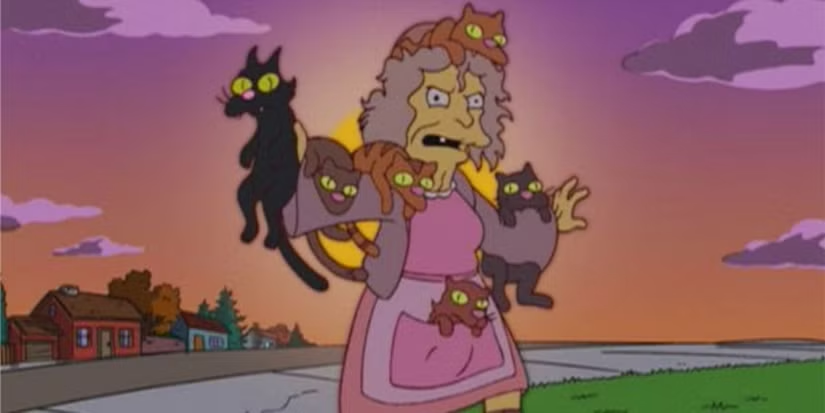
Take for example the ‘cat lady’ meme, which in its current popular mode may be said to have originated on The Simpsons, where the character of Eleanor Abernathy is depicted as being a demented old woman who shouts gibberish, hoards rubbish and clings to dozens of cats. Eleanor’s back story is that, as a highly intelligent young woman, she became overeducated, studying both Law at Yale and Medicine at Harvard, thereby foregoing romantic relationships and family and burning herself out intellectually, resulting in her fate as a ‘crazy cat lady’.

One does not have to ponder for long to see why this narrative appeals to the incels of the alt-right in their ongoing demonisation of feminism, female autonomy and what they perceive as the anti-family ramifications of educating women.

So the prevalence of cats as part of, or at least adjacent to, human domestic culture also means that they serve as bellwethers for cultural development. I am reminded of the 19th century viral practical joke, whereby people would place advertisements in newspapers, usually purporting to be from merchant sea captains, seeking to pay for cats which they wished to have on their ship to prevent rat infestations.

As a result, hundreds of people would flock to the docks of their city on the allotted day, only to find that no such captain or ship existed, and release the various strays and kittens they had gathered, thereby causing chaos (and one presumes amusement for the joker who placed the advertisement.) This joke ran for decades in various primarily British and American port cities, as my friend and former colleague Chris Smith has detailed in an essay on the matter.

As Smith points out, the originating event, an alleged cat hoax at Chester, never happened. But the fact that it was reported inspired copycat (sorry) events which definitely did. And the reason for this virality of what was originally an urban legend, the reason why people persisted in committing this hoax, was as Smith states to laugh at the poor, the uneducated and in particular the Irish.

So who do we use cats to laugh at today? Obviously women, in particular educated single women as I have already mentioned. But there are other targets too. Most recently a meme about the medieval papacy has gained a lot of traction on social media which features cats. It’s easiest to reproduce it here than describe it:

Now, the logic gap here may be obvious to anyone no matter how little they may know about Pope Gregory. If the papacy demanded the death only of black cats, surely all the cats of other colourings still existed and could have dealt with the rats whose fleas were the primary vector of bubonic plague into Europe? Someone with only the tiniest familiarity with medieval chronology might further protest that the outbreak of plague in Europe in the 1340s came at least a century AFTER it is suggested that Gregory launched his anti-cat campaign.

Vox in Rama does indeed exist. It is a Papal Bull which primarily discusses the alleged existence of a satanic worship ring in Germany and proposes its suppression. Killing cats is not proposed within it. Furthermore, it was directed only to a small number of German clerics, not to the clergy or Christian population of Europe as a whole. Now, this is not to say that Gregory is entirely innocent in all things. He was quite fond of instigating pogroms against heretics, of which Vox in Rama formed a part. But did his blindness to consequence and thirst to persecute inadvertently lead to the deaths of millions of people from the bubonic plague? Absolutely not.

So what are we really reading here? If the resurgence of the Simpsons Cat Lady is about male insecurity and condemnation of female outperformance in higher education and the workplace, and the 19th century cat hoax is about the lower middles of Britain sneering at the poor and the Irish simultaneously, then who is the target of the Papal cat genocide meme, and why?

Obviously the primary target is the Catholic Church. The meme trades on institutional Catholicism’s instigatory involvement in medieval persecution of heresy, from the Crusades to the Inquisition. But within that is a further layer of attack on male power and its concomitant stupidity, a failure to connect action to reaction, cause to consequence.

Whence does this actually stem? Most likely the inspiration is the success of a truthful meme, that of Mao’s war on sparrows as part of his ‘Four Pests’ campaign, which did indeed lead to the deaths of millions of Chinese people in the 1950s. The resurgence of this particular event as a meme on social media functions primarily as a cautionary tale against Communism, as well as a kind of Sinophobic warning against gullible and indoctrinated Chinese people. It would not be unfair to surmise that this meme has been primarily propagated by anti-Communist ethnonationalists in the West.

So what is the semiotic or cultural meaning of the Pope Gregory meme about cats? It is an attempt to respond to the popularity of the Mao meme by inverting and displacing it. Pleasant as sparrows are, human attachment to cats is much more significant culturally, and there is a general repugnance to the killing of cats in Western and other cultures. So Pope Gregory’s patriarchal, ignorant and cruel cat crusade (as depicted erroneously in the meme) is actually a response to what anti-Communist ethnonationalists find dear, that is, the Christian church via its primary institution.

We can expect the culture wars to continue apace, and it is likely that cats will increasingly be weaponised in this fashion as a mode of marshaling emotional responses on one side or the other. Smith’s illuminating and entertaining study shows how this is nothing new and is attested in history (and in media) long before the internet existed.