A Clockwork Vegan

Anthony Burgess once wrote a brief novel entitled A Clockwork Orange. It was one of at least three that he wrote in one year, though he claimed five and a half with his usual embroidery of the facts. As the not entirely accurate story goes, he was diagnosed with a brain tumour and given a year to live, so he decided to write as many books as possible in that one year to leave some kind of passive income for his first wife, who suffered from alcoholism.

Whether it was three or whether it was five and a half, it’s still a substantial achievement by any standards, not least because at least three of the novels he submitted for publication that year are stone-cold classics, and one in particular is still a bestseller over sixty years later. The classics, in case you were curious, were The Wanting Seed, Inside Mr Enderby and of course, A Clockwork Orange.

One of the reasons why A Clockwork Orange became so renowned is because of the cinematic adaptation by Stanley Kubrick in 1971, and the subsequent media meltdown about droog-style hooliganism attributed by tabloids to the novel and movie. This made both film and book cult artistic artifacts. But another reason is because A Clockwork Orange is one of the most succinct defences ever mounted in favour of human free will.

Alex, the teenage anti-hero of the novel, is a rapist of children, a multiple murderer, a violent, drug-addled hoodlum prone to bouts of ‘ultraviolence’ and random attacks on the general public. He is, in short, as unpleasant in his actions as any human could conceivably be. In his words, however, he is quite alluring. He is charming, creative, an appreciator of classical music, a clever coiner of his own invented phrases and language. It is the gap between his inner and outer worlds which makes A Clockwork Orange such a continually interesting book.

This brings me, as I’m sure you have guessed, to the possible societal benefits of insect bloodsucking and the recent proposal to make such benefits mandatory. No? Ok, let me explain. The bite of the lone star tick causes a condition called alpha-gal syndrome (AGS), which is notable for having one sole physiological effect – it causes an allergic reaction to the consumption of red meat. Now, this reaction is unpleasant but not fatal.

Furthermore, it is generally understood in contemporary Western society that overconsumption of red meat causes a range of adverse health conditions and that the meat industry itself is a net moral negative, due to the combination of karmic cost to the suffering animals turned to food product and these negative health conditions arising from their excessive consumption. We might add, as a kind of methane cherry on the pie of woe, the contribution that the cattle industry makes to the greenhouse effect, which is warming the planet and contributing to climate change.

In this context arises the modest proposal from two researchers that, instead of trying to find a way to mitigate the AGS effects of a lone star tick bite, instead society ought to be encouraging infection via the insect bloodsuckers as a net good for individuals and the world. By rendering people involuntarily vegan, or at least, making them incapable of consuming red meat, it is argued, society would enjoy a ‘moral bioenhancer’ effect.

Is there a counter-argument that goes beyond the employment destruction in the cattle farming and processing industries, or mere tradition, whether related to food production cuisine or otherwise? I believe there is and it is to be found in Anthony Burgess’s novel. A Clockwork Orange, and in particular the sometimes suppressed final chapter, argues convincingly that it is insufficient to force someone to do good as this strips them of their free will and by extension their very humanity. Rather, it is essential to lead them to goodness, to allow them to make mistakes and mature at their own rate, with due regard for the safety of the rest of society.

I have vegan friends and family. I am, I suppose, probably best described as vegetarian-adjacent myself in that I tend to eat very little to no red meat but reserve the right to do so on occasion. This is not, I accept, a particularly morally integral position, as it varies somewhere between habit and hedonism, without being grounded in any moral argument. But it is the product of my own free will.

What has led me to cut down my consumption of red meat radically in recent years was firstly the aforementioned adverse health effects and learning about them, and secondly finding myself in the company of friends and family who were vegan or vegetarian, but who crucially did not lecture or hector about it, but simply lived their own choice in accordance with their chosen morality, their own free will.

My slow slide towards an increasingly vegetarian diet is a result of their example, not any finger wagging and certainly not any imposition placed upon me from outside. I could say similar things about my minimal consumption of alcohol too. It was the example of moderation among Italians, and minimal consumption among Turks, that led me finally to abandon the kind of excessive drinking that remains so commonplace in Ireland and Britain.

By extension I could foresee being a teetotal vegan at some point. But that would have to be organically reached as a result of my own personal choice and not via an external imposition concocted via a pact between moralising medics and their bloodsucker proxies. In short, I think we all as human beings deserve the right to choose, and we all ought to be granted the opportunity to have the same kind of epiphany which Alex chooses in chapter 21 of A Clockwork Orange, an ending which is notably not to be found in the Kubrick movie.

I have a lot more to say about the cultural impact of A Clockwork Orange, but for that you’ll have to wait for my next academic monograph. More information on that soon I hope.

Let Them Eat Data

How long before the first dystopian novel or movie about starving, frozen, homeless hordes storming data centres?

Perhaps it already exists.

And how long before it happens for real?

It can’t be long now.

It’s a weird future the AI gurus envision where people don’t need light or heat or energy to cook or, in some locations where houses are being seized via eminent domain or compulsory purchase, even their homes.

Let them eat data!

The Cat Crusades in the Culture Wars

I’m not an especial fan of cats. Cats will be chewing your fingers and clawing at your eyeballs within minutes of your death. Cats are apex predators who devastate local wildlife. Cats are highly self-serving and have learned how to hack human attachment to them, in part with the assistance of toxoplasmosis, with which they infect us.

In short, I’m more of a dog guy.

But cats are also useful in many ways, providing company and comfort of a sort to the solitary, isolated or lonely. They keep vermin down. And their long history as domestic human companions can often be used to cast light on some social trends historically.

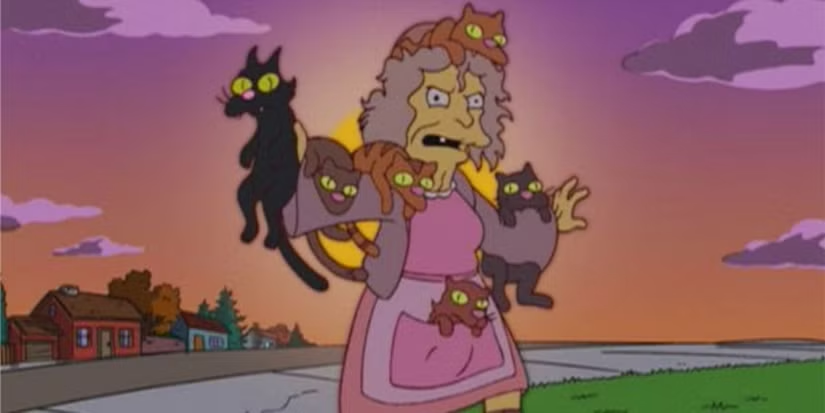
Take for example the ‘cat lady’ meme, which in its current popular mode may be said to have originated on The Simpsons, where the character of Eleanor Abernathy is depicted as being a demented old woman who shouts gibberish, hoards rubbish and clings to dozens of cats. Eleanor’s back story is that, as a highly intelligent young woman, she became overeducated, studying both Law at Yale and Medicine at Harvard, thereby foregoing romantic relationships and family and burning herself out intellectually, resulting in her fate as a ‘crazy cat lady’.

One does not have to ponder for long to see why this narrative appeals to the incels of the alt-right in their ongoing demonisation of feminism, female autonomy and what they perceive as the anti-family ramifications of educating women.

So the prevalence of cats as part of, or at least adjacent to, human domestic culture also means that they serve as bellwethers for cultural development. I am reminded of the 19th century viral practical joke, whereby people would place advertisements in newspapers, usually purporting to be from merchant sea captains, seeking to pay for cats which they wished to have on their ship to prevent rat infestations.

As a result, hundreds of people would flock to the docks of their city on the allotted day, only to find that no such captain or ship existed, and release the various strays and kittens they had gathered, thereby causing chaos (and one presumes amusement for the joker who placed the advertisement.) This joke ran for decades in various primarily British and American port cities, as my friend and former colleague Chris Smith has detailed in an essay on the matter.

As Smith points out, the originating event, an alleged cat hoax at Chester, never happened. But the fact that it was reported inspired copycat (sorry) events which definitely did. And the reason for this virality of what was originally an urban legend, the reason why people persisted in committing this hoax, was as Smith states to laugh at the poor, the uneducated and in particular the Irish.

So who do we use cats to laugh at today? Obviously women, in particular educated single women as I have already mentioned. But there are other targets too. Most recently a meme about the medieval papacy has gained a lot of traction on social media which features cats. It’s easiest to reproduce it here than describe it:

Now, the logic gap here may be obvious to anyone no matter how little they may know about Pope Gregory. If the papacy demanded the death only of black cats, surely all the cats of other colourings still existed and could have dealt with the rats whose fleas were the primary vector of bubonic plague into Europe? Someone with only the tiniest familiarity with medieval chronology might further protest that the outbreak of plague in Europe in the 1340s came at least a century AFTER it is suggested that Gregory launched his anti-cat campaign.

Vox in Rama does indeed exist. It is a Papal Bull which primarily discusses the alleged existence of a satanic worship ring in Germany and proposes its suppression. Killing cats is not proposed within it. Furthermore, it was directed only to a small number of German clerics, not to the clergy or Christian population of Europe as a whole. Now, this is not to say that Gregory is entirely innocent in all things. He was quite fond of instigating pogroms against heretics, of which Vox in Rama formed a part. But did his blindness to consequence and thirst to persecute inadvertently lead to the deaths of millions of people from the bubonic plague? Absolutely not.

So what are we really reading here? If the resurgence of the Simpsons Cat Lady is about male insecurity and condemnation of female outperformance in higher education and the workplace, and the 19th century cat hoax is about the lower middles of Britain sneering at the poor and the Irish simultaneously, then who is the target of the Papal cat genocide meme, and why?

Obviously the primary target is the Catholic Church. The meme trades on institutional Catholicism’s instigatory involvement in medieval persecution of heresy, from the Crusades to the Inquisition. But within that is a further layer of attack on male power and its concomitant stupidity, a failure to connect action to reaction, cause to consequence.

Whence does this actually stem? Most likely the inspiration is the success of a truthful meme, that of Mao’s war on sparrows as part of his ‘Four Pests’ campaign, which did indeed lead to the deaths of millions of Chinese people in the 1950s. The resurgence of this particular event as a meme on social media functions primarily as a cautionary tale against Communism, as well as a kind of Sinophobic warning against gullible and indoctrinated Chinese people. It would not be unfair to surmise that this meme has been primarily propagated by anti-Communist ethnonationalists in the West.

So what is the semiotic or cultural meaning of the Pope Gregory meme about cats? It is an attempt to respond to the popularity of the Mao meme by inverting and displacing it. Pleasant as sparrows are, human attachment to cats is much more significant culturally, and there is a general repugnance to the killing of cats in Western and other cultures. So Pope Gregory’s patriarchal, ignorant and cruel cat crusade (as depicted erroneously in the meme) is actually a response to what anti-Communist ethnonationalists find dear, that is, the Christian church via its primary institution.

We can expect the culture wars to continue apace, and it is likely that cats will increasingly be weaponised in this fashion as a mode of marshaling emotional responses on one side or the other. Smith’s illuminating and entertaining study shows how this is nothing new and is attested in history (and in media) long before the internet existed.

Does the Protagonist wear Prada?

Writers have their little tricks. Nearly all of them use a thesaurus to avoid overusing their favourite words, for example. And some like to dip into a phone book (or its modern equivalent the internet) to generate names for characters.

I’ve been writing fiction on and off for nearly four decades (no jokes about my journalism career please!), ever since Heinemann published me alongside Salman Rushdie, Nadine Gordimer, William Trevor and others in their Best Short Stories of the Year anthology when I was still in short trousers, so to speak.

But one thing I’ve never managed to do successfully is dress characters.

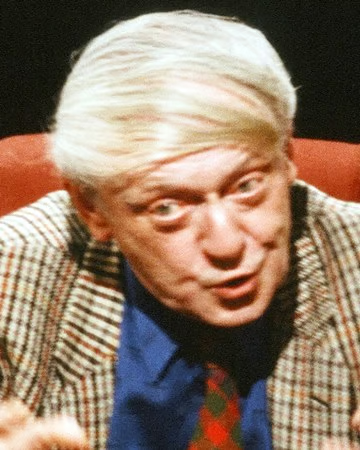
Anthony Burgess was a famously terrible dresser, partly because he was colourblind. If you watch him on old chatshow clips, he’s wearing brown shirts with green ties and so on.

But he knew his characters deserved better, so he would get his glamorous Italian wife to tell him what each of his characters ought to be wearing.

That’s what I could definitely use – someone to dress my characters for me. (Not the glamorous Italian wife – I’d need to be on Anthony Burgess level royalties to afford one.)

The Cosy Sectarianism of the Great Irish Writers

How cosy and quaint do the petty sectarian bigotries of 20th century Irish writing seem today.

I’m not referring to the civil war in the North of Ireland, usually euphemistically referred to in a diminished manner as the ‘Troubles’. I lived through most of that, and it was extremely unpleasant indeed.

Rather I mean the slightly earlier period of the early and mid-twentieth century, when Irish writing bestrode the world in the forms of giants like Joyce, Beckett, Yeats and Behan.

What’s interesting, considering just these four (though we could add many other lesser names), is the varying personal reactions to the sectarian divide in Ireland. For the Protestant-raised, middle-class and cosmopolitan Beckett and Yeats, minor distinctions in flavours of Christianity was an irrelevance at best.

Yeats in later life veered into mysticism, theosophy, magick and the occult. Beckett by contrast tended to dismiss Christianity if not all religion entirely, referring to it as “all balls”, though conceding that it amounted to more than merely “convenient mythology”. Raised in the era they were, both Yeats and Beckett imbibed plenty of Christian dogma in school and wider culture however, and both demonstrate in their writing an easy and deep familiarity with Christian writings and the Bible.

Beckett, probably not considering conversion to Catholicism

By contrast, the Catholic, lower middle-class/working class Joyce and Behan seemed unable entirely to shake off the tribal Catholicism of their backgrounds and education. I was reminded of this recently when I re-encountered Behan’s hilarious take on Anglicanism:

Don’t speak of the alien minister,

Nor of his church without meaning or faith,

For the foundation stone of his temple

Was the bollocks of Henry VIII.

Behan wearing a rosette proclaiming what is undoubtedly the greatest sporting chant ever.

Behan was a self-described “daylight atheist”. This is often presented online in the form of a quote: “I’m a communist by day and a Catholic by night”. However, I’ve not found a reliable source for this variant. Anyhow, Behan clearly had not managed to transcend the petty sectarian rivalries which beset Ireland, and in this he echoes Joyce, who in the highly autobiographical A Portrait of the Artist as a Young Man describes his alter-ego protagonist Stephen Dedalus refusing to consider conversion to Protestantism:

– Then, said Cranly, you do not intend to become a Protestant?

– I said that I had lost the faith, Stephen answered, but not that I had lost self-respect. What kind of liberation would that be to forsake an absurdity which is logical and coherent and embrace one which is illogical and incoherent?

We might consider this passage as a depiction in mature adulthood of his prissy adolescence were it not that it is echoed elsewhere in his work, such as the short story ‘Grace’ in Dubliners.

Joyce in his lengthy European exile.

It’s worth remembering too that Joyce and Behan both escaped the confines of petty Ireland if anything more completely than Yeats ever did, the latter becoming a senator in the newly independent Ireland whereas Joyce relocated permanently to Europe, while Behan spent much of his time in London and America. (Beckett like his mentor Joyce went to Europe and never looked back.)

So then, what fuels this seemingly pointless animus? The grounds of objection from both Joyce and Behan relate to an apparent illogicality inherent to Protestantism. Notably in both instances, there is no defence of Catholicism offered, merely a snide (and in Behan’s case, very funny) dismissal of Ireland’s second-largest faith.

And unlike Yeats, neither sought to construct a religious faith of their own, though in Joyce’s case at least there was an astonishing attempt to replace the religious impetus with an aesthetic one, succinctly underpinned as Joyce said, by “silence, exile and cunning.”

I think Behan’s piece (a translation as it happens from 16th century Irish) gives the game away here. In many locations, the first line of his translation is misquoted as referring to “your Protestant minister”. But Behan like his source material makes clear that while Anglicanism is being referred to, the issue is less the protest against Catholicism underpinning it than its alienness, that is, the fact that it was the faith of the foreign (ie English) overlords who governed Ireland from the time of bebollocked Henry to their present day.

In other words, it was an atavistic political tribalism rather than a theological objection. We still have those tribalisms in Ireland today, primarily in the North where those overlords remain in position, likely against their will and desire, due to the complexities of establishing a permanent and lasting peace. In the 26 counties of the Irish Republic however, these passages stand out as glaring anachronisms now.

And even in the North, the late great “famous” Seamus Heaney (like Yeats and Beckett a Nobel laureate) is best described as sociologically post-Catholic rather than a devotee of the creed of his birth. This runs counter to the opinions offered by some of his most astute critics, Conor Cruise O’Brien and Edna Longley in particular of course, but is it unfair to point out that both critics came from Protestant backgrounds and hence saw the cultural references to Catholicism in Heaney’s work as more significant than it was simply because those references were alien to them in the same way that Protestantism was to Behan?

So, will you be converting to Protestantism, Seamus?

In other words, the sensitivities may be reversed here. Perhaps it is as readers that we detect these curious emphases. Perhaps we misconstrue the petty cultural rivalries of sectarianism in mid-20th century Ireland because religion played such a larger role in cultural life in those days, in ways that anyone under 50 is unlikely to recognise in Ireland today.

The great Irish writers never stop teaching us, and one of their lessons is that we must challenge ourselves as readers with regard to what we find striking in their writing. What we notice and what we do not says perhaps as much about us as it does about them. They hold a mirror to our souls, even if, like Behan, we are daylight atheists.

Nobel Pursuits

Already it’s October, when the leaves turn red and fall from the trees, the nights grow longer and the days colder, and the Nobel prizes are awarded.

The Nobel committee for lit does tend to go leftfield when possible. One is therefore required to read into their decisions, a little like ancient haruspices reading the entrails of chickens or 20th century Kremlinologists interpreting the gnomic actions of the politburo.

How then should we read the decision to anoint the sparse, harsh and uncompromising pseudo-autobiographical work of Annie Ernaux?

To me it seems like a commentary upon Michel Houellebecq and Karl Ove Knausgård. All three are known for writing their big books of me, but perhaps the men are better known than Mme Ernaux internationally. Equally, both Houellebecq and Knausgård have been heavily criticised, among other things, for their misogyny. Awarding Ernaux seems to me to be a reaction to their popularity and the fact that both have been tipped for this prize previously. Your mileage may vary.

(Full disclosure: I’ve never read Knausgård or Ernaux and have at best a passing familiarity with Houellebecq, who I found to be a very rude interviewee at the Dublin Impac Award in a previous millennium.)

Also elevated to laureate this year was Svante Pääbo, the man who proved that ancient hominid species such as Neanderthals did not entirely die out but in fact persist to this day within non-African human genomes. In fact, I likely owe some Neanderthal ancestor the gene which oversees my melanocortin-1 receptor proteins, which gave me my once russet beard.

What’s intriguing personally for me about this year’s Nobels for medicine and literature isn’t that I’d not previously heard of the literature recipient, nor that I had previously heard of the medicine recipient, but the fact that both these things occurred in the same year. I guess my interests have shifted over the decades away from solely literary pursuits, and towards scientific interests, especially in early hominids. This year’s prizes have brought that home to me, and congratulations to the winners.

I’ve long criticised the Nobel Prize for Peace, because the Norwegian parliament committee which awards it has a knack for often choosing inappropriate recipients. Hello Henry Kissinger, Aung San Suu Kyi, Barack Obama, UN “peace-keeping” forces, etc.

Nevertheless, I’d argue they got it right this year. The 2022 Nobel Peace Prize has been awarded to human rights advocate Ales Bialiatski from Belarus, the Russian human rights organisation Memorial and the Ukrainian human rights organisation Center for Civil Liberties. Congratulations to them too.

POST-SCRIPT: The newest Nobel physics laureates have also been announced and their award is for proving that reality, as we understand it currently, is not real in the ways we think it is. Not awarded, though clearly the forefather of all of this research (which aimed to prove his hypotheses) is my compatriot John Stewart Bell, who alas died in 1990 while the experiments proving him correct were still in process.

John Stewart Bell

Congratulations to Alain Aspect, John F. Clauser and Anton Zeilinger for proving once again that the universe is not only stranger than we think, but most likely as Heisenberg noted, stranger than we can think.

Waiting for Wakenight

I’m not really a Joycean scholar (though I did once publish on Joyce, Anthony Burgess and counterpoint here) so it’s taken me this long to come across the suggestion (attributed by Finn Fordham to an unnamed critic, presumably Danis Rose) that in addition to a Bloomsday, there may be a Wakenight also.

According to the unnamed critic, the Wake takes place (in the same way Bloomsday does – in a fictional alternative history which lives on the page and in our minds) on the night of the 28th of March 1938.

It’s not an especially memorable date in actual history. A couple of weeks after the Anschluss, Hitler gave a speech in Berlin. For a further sense of the era, Westminster was debating both the cinematographs bill and a civil aviation bill.

This means, of course, that I was born on the 33rd such Wakenight, in the morning, just as the river Anna Livia Plurabelle ebbs into the sea, her father, and dies (only to be reborn again on page one of the book.)

I’m not sure how we’d celebrate Wakenight. I’m not sure Joyce entirely foresaw people strolling in Dublin each June dressed in boater hats and munching gorgonzola sandwiches either. So I guess it’s up to us to choose our own modern and secular rituals for our own post-religious deities.

Bloomsday.

My modest suggestion, in keeping with the source ballad, is that we all drink whiskey until we collapse as if dead. Who’s in?

Speaking of the ballad, let’s have a quick round of it now, courtesy of the inimitable Mark Wale:

What can we learn from Johnny Depp and Amber Heard

I refrained from posting anything about the Depp-Heard hearings because I don’t know these people and they don’t impact my life at all.

In the obscene orgy of public cheerleading on social media, it became evident that many people were overly engaged and inappropriately so, treating it like a sports game which required a colosseum audience.

Johnny Depp e Amber Heard, la loro storia al centro di un documentario
Surface image =/= Reality

It’s clear also in the aftermath that the media itself was also culpable of partisan viewing and foregone conclusions. Amid the many hamfisted attempts to map the peculiarities of this case to ALL women, ALL men, the most salient point, for which I thank both Heard and Depp, was almost totally ignored, which is this:

Hollywood takes desperate narcissists and feeds them vast wealth, public platforms, and stimulants, resulting in lives which while idyllic on the surface prove later to be beyond appalling.

Ordinarily we must wait for such people to be long dead to discover the horror of their existences. We owe Heard and Depp our gratitude for lifting the veil so comprehensively on the truth of their sordid and horrifying marriage.

How Utopia may grow from Coal Black Suburbia

The best band of the Britpop era was not Blur or Oasis, nor even Pulp, but Suede.

(Shout outs to Ash, Echobelly, Sleeper and Gene too.)

So it’s been interesting reading Brett Anderson’s brief memoir, Coal Black Mornings, of the period up to the point where he became famous and his story devolves into, as he put it, “the usual ‘coke and gold discs’ memoir”.

Coal Black Mornings (English Edition) eBook : Anderson, Brett: Amazon.it:  Kindle Store

Comparing it to David Mitchell’s novel Utopia Avenue, which features a fictional band from the Sixties, it’s interesting to see the many overlaps. The early sections of Utopia Avenue are easily the most interesting.

Both are tales of three-bar fires, poky terrace houses, distant parents, and the edgy tedium of suburbia, all opening up into a London which is equated to liberty, albeit a grimy, pot-infused, impoverished kind of freedom.

The conclusion of Mitchell’s novel, bar one not-especially-shocking twist, devolves to the same hotel rooms, drugs and hangers-on narrative one can find in any rock or pop memoir. One suspects Mitchell had nowhere else to go.

One also wonders whence he derived where the novel came from. Anderson’s origins are far from unique (mine shares many of the same attributes, albeit with the added frisson of a low-level civil war going on at the edge of the stage). But I wonder whether Mitchell read Anderson’s book before completing his own?

More memoirists should consider Anderson’s approach rather than speeding through their childhoods to get to the fame bits. Fame is boring and monotonous, and judging by the opinions of the occasional famous person I’ve met, somewhat of a trap and a burden. We are made by our youth and it is there where we may be found.

Thanks to the success of this first volume, Anderson wrote a follow-up about his fame years. It gets pretty good reviews, but as with the latter portion of Mitchell’s novel, I suspect it might disappoint, so I intend to leave his story hanging, perpetually suspended on the brink of success.

The Grapes of Wolf

When it comes to lost works of literature, John Steinbeck’s unpublished werewolf mystery amounts to five words I never imagined I’d ever write in that order together.

Werewolves and Wildness: The Open Graves, Open Minds special issue of  Gothic Studies - Edinburgh University Press Blog

Okay, it perhaps might not carry the same cultural weight as rediscovering Aristotle’s volume on comedy, or Shakespeare’s Love’s Labours Won, or Gerard Manley Hopkins’ early poetry, or James Joyce’s lost stageplay.

But in terms of sheer unexpectedness, it’s on a par with hearing of the existence of Ernest Hemingway’s secret gay erotica, Franz Kafka’s rediscovered techno thriller, or Sylvia Plath’s long forgotten shopping and fucking chicklit.

Actually, it’s even less likely than all of those. But, we are assured, nevertheless, it exists.

Publish it now, dammit!