The multiplying tensions of religion(s) and the future

Just a quick observation on religious futurism(s).

With religions, we might term revelatory knowledge, which is deemed to be eternal, of divine or suprahuman provenance and therefore unchangeable wisdom. With the scientific method, we have a progressive, though unending, search for fundamental reality, generated via the attempts to disprove hypotheses empirically.

There is clearly a potential if not actual tension between the two, and we’ve seen this in the centuries since the Enlightenment period when the scientific method first came to the fore.

What happens when we add the temporal factor of futurism to the mix? Do we add tensions or multiply them? How do they manifest?

It’s going to be different for every religion, predicated on the nature of each faith’s own sense of revelatory knowledge of course. Some will be more malleable than others, and some more malleable on certain topics than others.

It’s also dependent on two other aspects which are perhaps less immediately obvious. The first of these is the future vision embedded within a particular religion. If a faith has a designated end point, in terms of apocalypse, apotheosis or otherwise, then obviously any world view based on that faith assumes that the world is moving inexorably towards that position, perhaps at varying speed, perhaps with occasional setbacks, but overall, invariably towards a set destination point.

The second aspect which may not be so obvious is a particular religion’s comfort zone in terms of adapting to scientific developments. A more fundamentalist faith is going to struggle with this more than a less rigid one, for example. In this sense, some religions may be somewhat surprising.

Catholicism is often perceived, from outside at least, as antipathetic to science due to anti-scientist positions it occasionally assumed during the Inquisition period. Nevertheless, Catholic clerics have played significant roles in the development of a number of scientific breakthroughs – genetics to name but one – and the Vatican observatory today is one of the leading institutions in the search for extraterrestrial intelligence. In short, Catholicism has a strong sense of futurism even if elements of its dogma are not especially malleable or open to debate.

Islam likewise has been a strong supporter and fellow traveller of science at various geographic and historical points, and has no issue with futurist concepts such as alien intelligence, or space travel.

By contrast, Buddhism, which is often understood at least by non-practitioners as one of the more rational, or less revelatory, forms of faith, has a number of points where it finds scientific rationality tricky to engage with. There are reams of books attempting to square this particular circle, some of them inspired by or even co-authored by the Dalai Lama, who is well aware of just how hidebound his own particular variant of Buddhism is.

What is the disconnect here? The answer of course is adherence to the notion of a godhead. The Abrahamic monotheisms are unapologetically attached to the concept of a creator deity. It’s their core belief. Buddhism on the other hand manifests very differently. Some forms, inspired by Hinduism, have many supernatural beings in their pantheon. Tibetan Buddhisms in particular are prone to this. Others, and one thinks of some of the more austere Theravadan forms, do not espouse gods of any kind or form.

Because of the existence of the latter, Buddhism MAY not require belief in a godhead, and therefore it has tended to be perceived by atheists who practice science (or who practice futurism, in the form of science fiction or otherwise) as potentially more acceptable. The reality on the ground and across the entirety of the belief complex, is not as clearcut of course.

As always, I do not have any simple answers here, especially as answers would require the power of prophecy. It is unknowable how religions will develop in the future alongside further scientific insights and discoveries, because it depends on the nature of the discoveries, how they relate to existing revelatory dogma in various faith forms, and how faiths respond to apparent contradictions.

But it does seem to me that the simple tension between revelatory knowledge and empirically tested knowledge leads to a much more complex relationship when we try to project any of this into the future.

And based on the study I have personally done on Anglophone SF and its relationship with Catholicism, and now Buddhism, it seems to me that the futurists are to date struggling to encompass the complexities of that potential relationship.

Defining Religious Futurism

We need a way of taxonomising religious futurisms due to the wide range of territory the term covers. There are three main strands of religious futurism, with a number of additional topics that are at least cognate or germane.

The first, and perhaps most recognisable, form of religious futurism simply describes futurisms derived from existing terrestrial religions, for example Islamofuturism. This form also includes futurised hybrids of these religions, such as the Zensunni and Orange Catholic beliefs described in Frank Herbert’s Dune.

The Orange Catholic Bible: In the Future the OCB will Unfold Reality:  Interplanetary Religion, International Council on: 9781508508724:  Amazon.com: Books

A second rich category of religious futurism relates to religious belief systems, or nascent belief systems, which are either influenced by or directly derivative of SF, for example the Church of Scientology or Jedi beliefs.

Inside the Church of Jediism, Where 'Star Wars' Gets Spiritual
Church of Jediism

An additional main strand of religious futurism, what we might term creative or speculative religious futurism, relates to invented religious faiths ascribed either to future populations or alien civilisations in SF and cognate genres, such as the Church of All Worlds in Robert Heinlein’s Stranger in a Strange Land, or Bokononism, which Kurt Vonnegut invented for his novel Cat’s Cradle.

Where we get some lack of clarity is in overlaps. There is evidence, for example, that religious futurisms of this latter category can migrate into the previous one. There is some evidence, for example, of people pursuing Bokononism in reality, and clearly Jedi commenced as a created belief system depicted within the Star Wars universe, and was not originally intended to be a religious belief. Indeed, to become one, it had to be fleshed out with doctrine by fans.

Cat's Cradle - Wikipedia

But then what of something like Scientology, which emerged from L. Ron Hubbard’s work on Dianetics, and was clearly influenced by his own career as a SF author, but was presented to the world as a revelatory knowledge? Or what of Mormonism, also presented to the world as a revelation, but one which in its origin story as told by proponents clearly contains elements of fantastika, if not overt SF futurism?

There are other anomalies too. What do we make of the non-theist belief system propagated in Iain M. Banks’s Culture novels, where most of the population believe the universe they inhabit to be a simulation? This particular theory, first popularised by Nick Bostrum, is gaining a lot of traction among both physicists and the general public. Is it, too, a religious futurism? Is religious even the correct descriptor? Is futurism?

Simulation Theory
Simulation Theory

As we expand in focus, the anomalies proliferate in this regard. Given the fantastikal aspect of most revelatory origin stories for religions, are we to retroactively consider all religions as religious futurism at an early stage of their development? If we locate the concept of futurism as relative to now, ie the present day, does that simply create a kind of moving walkway, in which, perhaps, Jedi beliefs will at some point cease to be religious futurism and simply become religion? What, other than the passing of time, is required for it to qualify otherwise?

In my own work on SF and Catholicism, I’ve sought to identify how the Anglophone literary tradition of SF constantly depicts Catholicism of the future as a threat – oppressive, anti-science, threatening to democracy and liberty, totalitarian in many aspects.

But this Catholic futurism is not the same as describing the actual likely organic evolution of Catholicism, which has to its credit, played a significant role in a range of scientific development from genetics to astrophysics, and which in its liberation theology form in Latin America has strenuously defended liberty and democracy from totalitarian regimes.

In other words, I wasn’t attempting to predict the future of Catholicism at all, but rather to chart what future Catholicism signified to the Anglophone culture of the recent past.

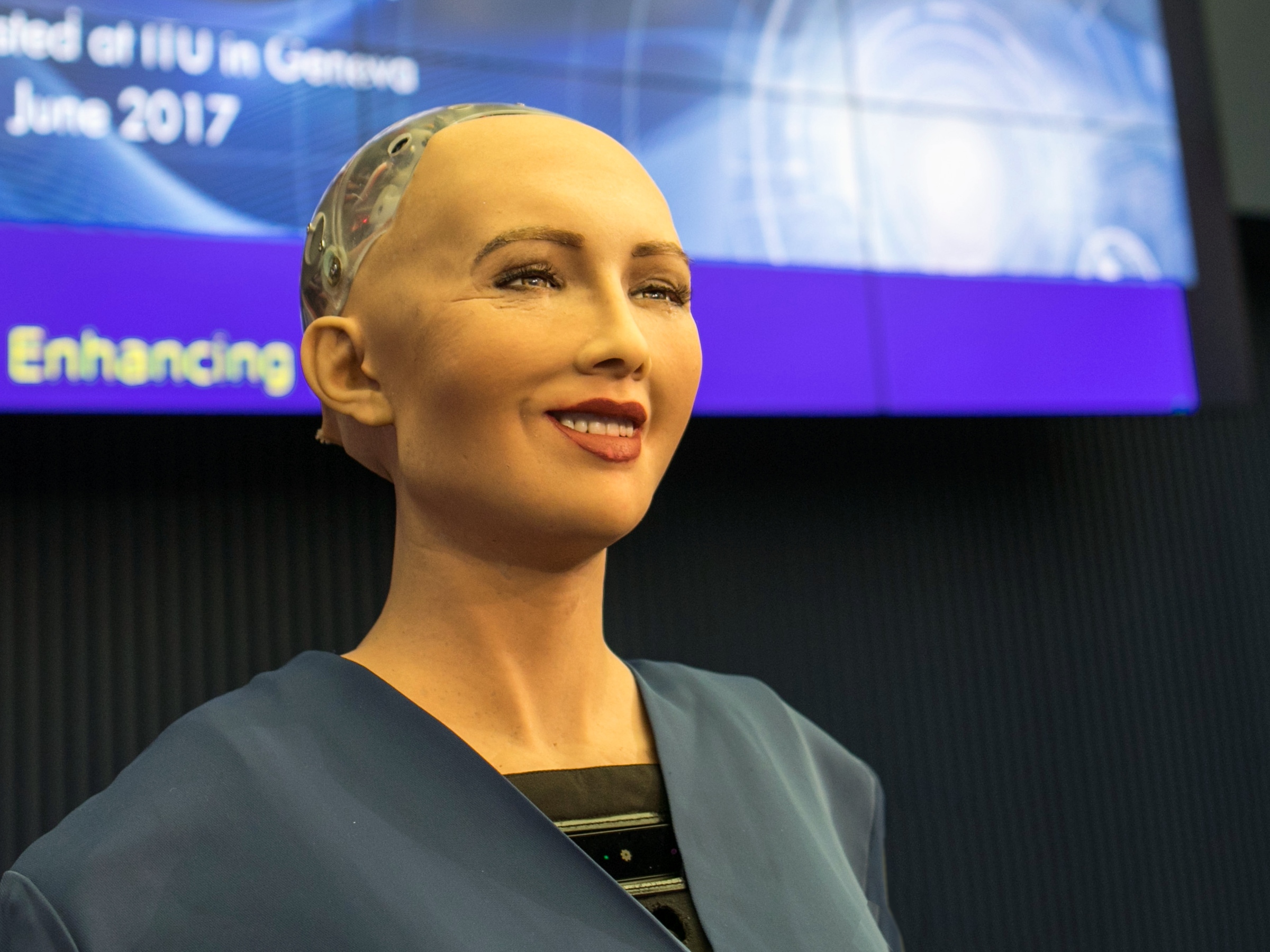
Likewise, we need to distinguish Islamofuturism from actual potential futures of Islam, though again the anomalies proliferate. What are we to make of Saudi Arabia, a highly conservative Islamic state, granting citizenship to a robot, the first ever robot citizen of any nation?

Sophie the robot citizen

I don’t claim to have easy answers for such questions. What I hope is that scholars of art, culture, the future and theology can start asking them and similar ones. Only collaboratively can we hope to close in on a working definition of religious futurism.

What is religious futurism?

Best perhaps to start with what it’s not. It’s not a form of futurology, or attempting to predict what has yet to take place. Few people during the tenure of Pope John Paul II would have predicted that his right-hand man would relinquish Peter’s throne in favour of an Argentinian Jesuit. Futurology is best left to those who make a living mugging companies by claiming to predict societal trends, and gamblers. It’s simply not academic.

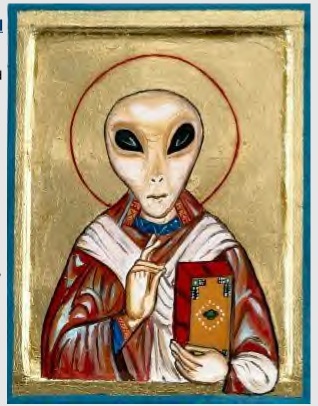
Futurism, on the other hand, is an attempt to read the the present through how it depicts the future. This means looking at cultural outputs, such as art and literature which address future-related themes and analysing them.

alien-priest painting 1400 AD | ANCIENT ARCHIVES

Recently there has been a number of shifts in focus in this area, casting new light on how previously marginalised visions of the future, emerging primarily from non-caucasian communities, envisage the road ahead. Afrofuturism, or aesthetic depictions of the future from an African(-American) perspective(s), is the most prominent, but there have been many from a disparate range of sources, all now thankfully achieving academic scrutiny and consideration.

Religious faiths have not been excluded from this process, despite the predominance of atheist beliefs among those who produce Science Fiction and other futurisms. However, they have yet to attain similar levels of academic attention. I have an interest in how SF and cognate art modes consider the future of religion in general, and Catholicism and Buddhism in particular. Other scholars consider how the Hinduism, or Islam or other faiths are envisaged as developing (or dying) in the future.

Religious futurism can help us understand not only how art, but also how society is responding to evolutions in world theology in real-time. It can allow us to process better the role of religion in the world by understanding better how the world imagines religion will be in years to come.