
I’m not an especial fan of cats. Cats will be chewing your fingers and clawing at your eyeballs within minutes of your death. Cats are apex predators who devastate local wildlife. Cats are highly self-serving and have learned how to hack human attachment to them, in part with the assistance of toxoplasmosis, with which they infect us.
In short, I’m more of a dog guy.
But cats are also useful in many ways, providing company and comfort of a sort to the solitary, isolated or lonely. They keep vermin down. And their long history as domestic human companions can often be used to cast light on some social trends historically.
Take for example the ‘cat lady’ meme, which in its current popular mode may be said to have originated on The Simpsons, where the character of Eleanor Abernathy is depicted as being a demented old woman who shouts gibberish, hoards rubbish and clings to dozens of cats. Eleanor’s back story is that, as a highly intelligent young woman, she became overeducated, studying both Law at Yale and Medicine at Harvard, thereby foregoing romantic relationships and family and burning herself out intellectually, resulting in her fate as a ‘crazy cat lady’.
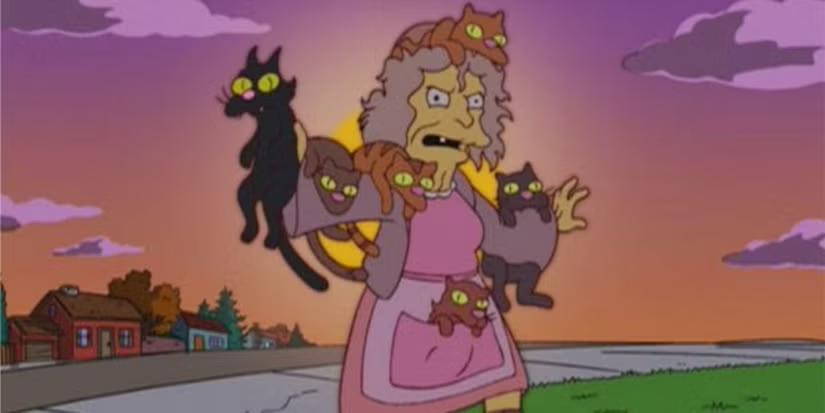
One does not have to ponder for long to see why this narrative appeals to the incels of the alt-right in their ongoing demonisation of feminism, female autonomy and what they perceive as the anti-family ramifications of educating women.
So the prevalence of cats as part of, or at least adjacent to, human domestic culture also means that they serve as bellwethers for cultural development. I am reminded of the 19th century viral practical joke, whereby people would place advertisements in newspapers, usually purporting to be from merchant sea captains, seeking to pay for cats which they wished to have on their ship to prevent rat infestations.
As a result, hundreds of people would flock to the docks of their city on the allotted day, only to find that no such captain or ship existed, and release the various strays and kittens they had gathered, thereby causing chaos (and one presumes amusement for the joker who placed the advertisement.) This joke ran for decades in various primarily British and American port cities, as my friend and former colleague Chris Smith has detailed in an essay on the matter.
As Smith points out, the originating event, an alleged cat hoax at Chester, never happened. But the fact that it was reported inspired copycat (sorry) events which definitely did. And the reason for this virality of what was originally an urban legend, the reason why people persisted in committing this hoax, was as Smith states to laugh at the poor, the uneducated and in particular the Irish.
So who do we use cats to laugh at today? Obviously women, in particular educated single women as I have already mentioned. But there are other targets too. Most recently a meme about the medieval papacy has gained a lot of traction on social media which features cats. It’s easiest to reproduce it here than describe it:

Now, the logic gap here may be obvious to anyone no matter how little they may know about Pope Gregory. If the papacy demanded the death only of black cats, surely all the cats of other colourings still existed and could have dealt with the rats whose fleas were the primary vector of bubonic plague into Europe? Someone with only the tiniest familiarity with medieval chronology might further protest that the outbreak of plague in Europe in the 1340s came at least a century AFTER it is suggested that Gregory launched his anti-cat campaign.
Vox in Rama does indeed exist. It is a Papal Bull which primarily discusses the alleged existence of a satanic worship ring in Germany and proposes its suppression. Killing cats is not proposed within it. Furthermore, it was directed only to a small number of German clerics, not to the clergy or Christian population of Europe as a whole. Now, this is not to say that Gregory is entirely innocent in all things. He was quite fond of instigating pogroms against heretics, of which Vox in Rama formed a part. But did his blindness to consequence and thirst to persecute inadvertently lead to the deaths of millions of people from the bubonic plague? Absolutely not.
So what are we really reading here? If the resurgence of the Simpsons Cat Lady is about male insecurity and condemnation of female outperformance in higher education and the workplace, and the 19th century cat hoax is about the lower middles of Britain sneering at the poor and the Irish simultaneously, then who is the target of the Papal cat genocide meme, and why?
Obviously the primary target is the Catholic Church. The meme trades on institutional Catholicism’s instigatory involvement in medieval persecution of heresy, from the Crusades to the Inquisition. But within that is a further layer of attack on male power and its concomitant stupidity, a failure to connect action to reaction, cause to consequence.
Whence does this actually stem? Most likely the inspiration is the success of a truthful meme, that of Mao’s war on sparrows as part of his ‘Four Pests’ campaign, which did indeed lead to the deaths of millions of Chinese people in the 1950s. The resurgence of this particular event as a meme on social media functions primarily as a cautionary tale against Communism, as well as a kind of Sinophobic warning against gullible and indoctrinated Chinese people. It would not be unfair to surmise that this meme has been primarily propagated by anti-Communist ethnonationalists in the West.
So what is the semiotic or cultural meaning of the Pope Gregory meme about cats? It is an attempt to respond to the popularity of the Mao meme by inverting and displacing it. Pleasant as sparrows are, human attachment to cats is much more significant culturally, and there is a general repugnance to the killing of cats in Western and other cultures. So Pope Gregory’s patriarchal, ignorant and cruel cat crusade (as depicted erroneously in the meme) is actually a response to what anti-Communist ethnonationalists find dear, that is, the Christian church via its primary institution.
We can expect the culture wars to continue apace, and it is likely that cats will increasingly be weaponised in this fashion as a mode of marshaling emotional responses on one side or the other. Smith’s illuminating and entertaining study shows how this is nothing new and is attested in history (and in media) long before the internet existed.