The Future of the Call to Prayer

Religion is noisy. Ok, not always. Buddhists like to meditate in silence, for example. But they also like to chant mantras. Most religions have some form of collective ritual singing. And some like to advertise their wares to the public.

Christian churches have used bells to do so for many centuries. In areas with large Jewish populations, like Jerusalem or New York, a siren is sometimes used to warn devout Jews that Shabbat is about to begin, meaning they must cease certain activities. But easily the most prevalent form of religious noise pollution is the Islamic adhan, the call to prayer issued from mosques five times daily.

These days, the world’s four million or so mosques tend to use loudspeakers to project the sound of the muezzin as far as possible. This is, of course, a recent tradition, dating from the 1930s. There was obviously no amplification in the time of the prophet. In an increasingly multicultural (and in many places secularising) world, the sound of the adhan is becoming a divisive issue.

Pasha special edition, part 2: The significance of the call to prayer in  Islam

Indeed, even in religiously homogenous locations like Saudi Arabia, the issue of noise pollution has led to legal restrictions on how loud such amplification may be. In a 24/7 world where many people work non-traditional hours, and fewer people adhere to the daily timetable envisaged by traditional Islam, the call to prayer can be actively disruptive, disturbing the sleep of shift workers and irritating non-adherents who may view it as a kind of sonic religious imperialism.

But since the amplification of adhan is not Quranically prescribed, there is of course the possibility that current or future technological developments could help to resolve these issues. The question is the purpose versus the tradition of the call to prayer. If the purpose is to inform Muslims that it is time to pray, this could be done via, for example, a phone app. Sign up for the app, and the phone will recite the adhan to you at the designated times. This technology is already possible.

However, tradition dicates that the call to prayer must emanate from the mosque itself, sung by a muezzin. Of course, in reality, this doesn’t always quite happen. Very often, as the telltale bleeps at the end indicate, the adhan is a recording, transmitted from a mobile phone to the amplification system. No one is actually singing live from the minaret in most instances.

Tradition would be satisfied by a return to the pre-1930s days of live muezzins singing the adhan without amplification. Purpose could be satisfied by an adoption of modern telecommunications technology. Neither of these things are currently happening however, and instead we see the outbreak of often impassioned debate over the noise levels of amplified recordings from mosques.

Indonesian authorities, who have in the past jailed people from complaining about the noise levels of mosques, nevertheless accept that in many cases the call to prayer is significantly over-amplified in an attempt to reach as far as possible, leading to distortion as well as sound overlap when multiple mosques are broadcasting slightly out of synch.

Arguments about permission to broadcast the adhan in traditionally non-Islamic locations, or about the volume levels in many Islamic locations like Indonesia or Saudi, tend to run passionately. Allegations of Islamophobia or NIMBYism are sometimes used to drown out legitimate concerns, such as the annoyance to non-adherents and secular populations in multicultural communities, or the disruption to shift workers, infants and others who need to sleep when the call to prayer is blaring. There have been such complaints in America, Israel, Britain, Germany and many other places already.

We are likely to see more of such arguments in the future as Islam is the fastest growing religion worldwide, and is increasingly gaining footholds among communities which do not adhere to the religion.

So the question remains – if the purpose is to alert Muslims to prayer times, why not use contemporary technology to do so in a non-obtrusive manner? Or alternatively, why is it not acceptable to return to the traditional form of live unamplified singing which was the sole mode of the adhan for centuries?

The answer may be that the adhan has become in some locations a kind of proselytisation in itself, or to put it another way, an attempt to Islamise the soundscape of an area. It is this suspicion which provokes resentment and reaction among non-Islamic and secular populations. If so, it’s a self-defeating form of proselytisation. Few people are likely to be persuaded by becoming irritated, or woken in their sleep.

The future for the call to prayer is likely to remain fraught in many places until mosques start looking at the 20th century technology they currently use, and either consider how to update that technology in less obtrusive ways, or else revert to the traditional method of live unamplified singing, which is aesthetically pleasing and offensive to no one but actual Islamophobes.

Allah (PBUH) after all is unlikely to be impressed by overamplified and distorted fuzzy recordings.

The War on Abstraction

War on terror can mean devastating Middle Eastern countries on fabricated evidence, or simply comforting a child having a nightmare.

War on drugs could mean burning poor farmers crops in Colombia and Afghanistan, incarcerating ravers, introducing CBT counselling for people stranded for decades on SSRIs, or murdering addicts in the Philippines.

War on crime can mean targetting gangland bosses with tax legislation, incarcerating youth for minor offences, or overpolicing black neighbourhoods in America and Catholic ones in Belfast.

What we REALLY need is a war on policians using abstractions.

The next time a politician says he intends to tackle homelessness, we should make him play soccer with some rough sleepers. Ninety minutes of getting kicked about the pitch might not change much, but it would at least be less corrosive than whatever he actually intended to do.

What can we learn from alternative Israels?

Earlier this year, I started working on a project looking at manifestations of the Jewish state in alternative history literature. The seemingly intractable weeping wound that is the Israeli-Palestinian conflict is, of course, a product of history, but a history which seems increasingly without any obvious resolution, or rather, one in which the much-vaunted two-state solution appears to satisfy almost no one.

After working on Science Fiction and Catholicism for some years, it seemed obvious to continue that work by examining Buddhist futurism. A book on this will, in the fullness of time, emerge, but for now readers will have to be satisfied with the sole tangible output to date, an article on Buddhist reception in Pulp Science Fiction. (Another on Arthur C. Clarke’s crypto-Buddhism, and one on the Zen influence over Frank Herbert’s Dune are also due to arrive in public shortly.)

But a second offshoot from that work on Catholic Futurism began to take shape in relation to Israel. Specifically, I wrote a chapter in that book on the cultural anxieties revealed by how Anglophone writers dealt with Catholicism through alternative history. The other timelines imagined by those writers were uniformally negative, envisaging retrograde Catholic empires crushing all science, innovation and progress under its clerical jackboot heel, which runs rather counter to the significant amount of support Catholicism has tended to offer to scientists historically.

Indeed, it says much more about how Anglophone writers, and specifically how ENGLAND perceives Catholicism – not as a cultural taproot but rather as a kind of fifth column infiltration which threatens their survival in an existentialist sense. This sentiment, I sometimes feel, is the archeological origin of things like opposition to the EU and the Brexit campaign.

Anyhow, when I began examining alternative history as a mode for exposing such cultural anxieties, it became quickly evident that the alternative timelines different cultures are drawn to evoke are a little like Rorschach blot tests, identifying their cultural anxieties in very clear ways.

As a test case, I chose Israel, primarily because it is in one sense a new nation, in another a very old one. Also, many writers of alternative history are culturally Jewish and this mode of artistic exploration is one that they are often drawn to. I was not disappointed by the results, and have been incorporating this work into my broader research project examining speculative geographies in literature.

Alternative histories about Israel reveal a series of cultural anxieties, from the obvious fear of Jewish annihilation (in early history at the hands of the Babylonians, Pharaonic Egypt or the Romans, but also during medieval pogroms in Europe, and obviously arising from the holocaust), as well as imagined reversals of such annihilation (particularly the fantasy of Judaic global dominance, sometimes by converting the Roman Empire).

There is a particular phylum of these alternative histories which explores other geographic locations for a Jewish ethno-state. This is also real-world history, as the Zionist Council under Theodor Herzl did indeed consider locations other than historic Palestine for the creation of such a state. Actually many locations were seriously considered, by both Zionists and non-Zionists, and some territories were even offered by certain nations, during the interim between the emergence of Zionism as a political movement in the late 19th century and the creation of Israel in 1948.

I’ve been examining the literary manifestations of these real-world alternatives, to see in what way they unveil cultural anxiety about both the conflict with Palestinians and the Jewish relationship with Europe (from whence many current Israelis, especially the Ashkenazim, derive much of their cultural inheritance). This work has identified a strong sense of determinism about the current location of Israel which interestingly is secular and not predicated upon the religious diktat of the Old Testament (though of course the Promised Land of Eretz Israel remains a significant cultural driver within Israel itself, especially among the Orthodox community.)

I hope to publish something on this soon, when I get a moment. But for now, all I can offer you is a slide or two (above) from my latest conference presentation on the matter, which took place at the Specfic conference at Lund University in Sweden last week.

Whose civilisation is it, really?

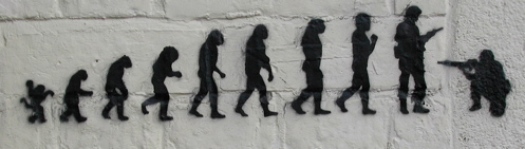
I carry Neanderthal DNA in my body. I am one of the modern humans, homo sapiens sapiens, who are descended from hybrid cross-hominid fertilisation that likely occurred somewhen during the overlap of populations in paelolithic Europe.

Of course, that side of the family died out a long time ago, leaving my sapiens ancestors to colonise Europe and indeed everywhere else on the planet.

Neanderthal DNA Can Affect Skin Tone And Hair Color : Shots - Health News :  NPR

I often wonder what we lost when we lost our hominid relatives – the Neanderthals, the Denisovans, the hobbit-like Homo Floriensis and so on. What might a world of multiple hominid species be like? How might we have accommodated our stronger, carnivorous and less gracile Neanderthal population? What might our tiny cousin with grapefruit-sized heads, the Floriensis hobbits, have contributed to our world?

Anyhow, the more I ponder the roads not taken, the less impressed I have become with our own boastful claims and achievements. Not simply because human achievement increasingly has come at the expense of all other species (initially the large mammals, then our fellow hominids, and now basically everything else). But also because even those achievements, it seems to me, may not really be ours to claim.

Air flight, modern medicine, computers? For sure. We made those. But let’s go back upstream to the origins of civilisation to see whose civilisation is it really?

Neanderthals used fire. Indeed, probably homo erectus, the ur-granddaddy of hominids used fire. Fire is a major issue. No other animal uses it. Most run terrified from it. But hominids tamed it, and found ways to use it for cooking and heat. If there’s one development which most explains why hairless apes like us and not, say, the gorillas or big cats rule this world, it is probably the taming of fire.

Neanderthals also buried their dead. This is a sobering thought really. In some senses so do elephants, and other species also demonstrate evidence of mourning, loss and grief. We may feel that grief is one of the things which makes us human, but it’s not an exclusively human sentiment. Even taking it to the point of ritual behaviour – burial – is not exclusive to us.

But what of the other foundational components of human culture and society? What about clothing, art, science, religion?

Well, Neanderthals made jewellery from seashells and animal teeth. Neanderthals created artwork on cave walls. Neanderthals invented musical instruments, specifically bone flutes. We can presume they knew how to beat on drums or rocks rhythmically too. After all, they also had hand axes, which would have been made and used with such rhythmical hitting. Neanderthals built stone shrines, and where there are shrines, it is highly likely that ritualistic behaviour took place.

Neanderthals used lissoirs, and hence invented hide preparation, and hence clothing. They invented glue and string and throwing spears which they used to hunt large game. These hunts required collective action and collaboration. Recent evidence suggests that Neanderthals may even have learnt to count and actually recorded their counting by notching scratches on bones.

So perhaps this isn’t OUR civilisation at all, when you think about it. Perhaps we are thieves living in someone else’s house, whom we murdered, looking at their achievements and claiming them as our own.

The Utopian Heresy

So, I was speedreading HG Wells again in advance of teaching him, in the context of his utopianism, and I ended up wondering about utopia’s relationship to societal scale.

In Wells, dystopia is usually us, by default. By contrast to his Modern Utopia, or The Shape of Things to Come, it is existing society which bears the taint, by default comparison, of dystopia.

But there are hidden hints of dystopia too, in the monstrosity of some of his earlier scientific romances – in the Eloi/Morlock symbiosis or on Moreau’s island, for example.

Anyhow, I began wondering whether a wrong turn we’ve made, in the 10,000 years since we expanded our societal size and complexity far beyond the Dunbar number, is in conceiving of utopia as a mass or universally applicable concept, and concomitantly, of dystopia as the plight of the individual in a negatively charged mass society.

Winston Smith undoubtedly lives in a dystopia. But how much of his dystopian encounter related to his individualism, his isolated rebellion against the monolith of Ingsoc? Would it have ever been possible for Smith, like the citizens of the Soviet Union, to somehow accommodate the totalitarianism? Can we, like Camus with Sisyphus, imagine Winston to be happy?

Anyhow, at the risk of assuming a taint of libertarianism, I wonder maybe we might have got it in reverse. Perhaps if utopia was understood as an individuated pursuit to project wellbeing outwards, whether desired or no, and dystopia as an immersion in a mass societal structure in which one size cannot fit all, nor even many, we might be onto something more fruitful.

Implicit in this idea, of course, is the suggestion of scale as an aspect of the issue, alongside the individuation of the Post-Enlightenment, something which itself has fallen subject to gargantuanism too, leading to the atomisation anomie so many people now experience. Is there a sweet spot somewhere between the individual self, thinking therefore being in a Cartesian moment of solipsism, and the uncountable hordes of contemporary existence? Professor Dunbar, as a good evolutionary biologist, suggests there is, hovering around his tribal size scale of approximately 150 individuals, though of course this does get queried.

No doubt, some of the reaction to the Covid pandemic, people seeking to leave cities for the country life in the first twitch of reversing the urbanisation we’ve seen accelerating throughout recent centuries, relates as much to an intuitive desire to rescale existence closer to the Dunbar number. This does not deny the desire for a lockdown garden, nor any of the other insights the world suddenly and collectively experienced in relation to the dystopic existence of modern city living, of course. They go hand in hand, down the pastoral path.

But if we must continue to operate in terms of didactic absolutes like utopia and dystopia, then maybe it would be more useful to envisage attempts to engineer society en masse as inherently dystopian motivations, even when couched, as they always, always are, in utopian and universal terms.

Equally, if we began to conceive of dystopia as a fundamental malaise experienced by the individual in response to the impossible complexities and incomprehensible scale of globalised society, then paradoxically it restores to us some human agency. Dunbar might essentialise this as something hardwired, inherent to our sapiens software. Without necessarily challenging that, I see it coming from both ends at once, both nature and nurture, the contradiction of Dasein in the megacity.

This still leaves us with the challenges that require scaled reaction of course. How to accommodate human liberty in a pandemic, or engage a global response to the climate crisis, just to iterate two particularly pressing examples of how individuated utopic desire might contradict the need to police the dystopic boundaries of global-scale societal infrastructure.

If I had an easy answer to that mode of contradiction I’d say so, but of course I don’t. Nevertheless, it does seem to me more sensible to start understanding utopic desire as an inherently dystopian practice when predicated on a societal level as it always has been to date. Likewise, there is a utopic emancipation inherent within dystopian structure, awaiting each of us as individuals to unleash it.

This is the paradox of the utopia/dystopia framework and paradigm as I see it. This is my utopian heresy.

The Cocaine Hippos of Posthumanism

Legally, we are already in the posthumanist era. Corporations have long been considered persons in certain jurisdictions, despite not facing the same potential limitations on their freedom as actual people. A couple of years ago, a stretch of the Magpie river in Canada was also granted legal standing as a person, as part of an attempt to provide it with environmental protection.

And now, the “most invasive animals on earth” have also been elevated to personhood, the late Pablo Escobar’s hippos.

Pablo Escobar's 'cocaine hippos' are being sterilized because the  population is out of control | Live Science
Don’t feed the cocaine hippos – even though they’re people now.

Ordinarily we understand posthumanism to be some sort of utopian merging of man and machine, but perhaps it might also, and better, be understood as a way of treating non-human entities with the same respect generally extended to humans.

Of course, I feel that implementing human rights (and responsibilities) for all humans might be required as a priority. We’re at risk of stratifying the world into a place where non-humans have more rights than some humans.

Which is the fundamental problem with posthumanism as a utopian ethos. Like all utopian ideals, it is utterly blind to the stratification it ushers into being, even while denying it is doing so.

Rewriting the big history books

Temporary decloaking continues apace, in order to acknowledge the existence of David Graeber’s final meisterwerke, which is no less than a history of everything. Alas, it’s only volume one, and he is no longer with us on this plane of existence to expand into the envisaged volumes two and so on. This makes it all the more valuable, in a sense, and there remains the faint hope that his co-writer will assume the mantle.

In short, I’d like Graeber to be right. It might offer us some routes (roots?) out of the post-Enlightenment “progress”-ratcheting one-way road to Hell we are now quite advanced along. And I think the politics of the time (and Graeber’s untimely death) mean this book will be enormously welcomed, in itself probably a net good, whether his theory is true, half-true, or not at all.

Ascent of Man – Peachey Conservation
You Are Here ———————————————————————————————–^

I suspect, though, that the established big histories, as popularised by the likes of Jared Diamond, Steven Pinker and of course Yuval Harari, are far from entirely defunct just yet. Furthermore, the undoubted impact of those existing grand narratives gives them a certain momentum which will hardly be slowed by the late intervention of Graeber.

(Full disclosure: I am complicit in such momentum, which I consider to be a positivist intervention/disruption in the current thanatocentric vector of humanity, as I am working with Sapienship, Yuval Harari’s educational vehicle. From what I can discern, the great insight of Homo Sapiens – that humanity’s tendency to collective fictions brought about an explosion of mass collaboration – does not appear to be challenged by Graeber’s work.)

Does Graeber offer us something new? He appears to be offering us a more complex picture, crucially one that suggests a greater sense of choice and agency for humanity writ both small and large. Is this itself a net good? Probably yes, even if his arguments transpire ultimately not to hold much water. We need hope, goddammit. Choice, even the illusion thereof, is a form of hope.

I’ll know more when I read the book, of course, which is all I want for Christmas (apart from world peace, an end to hunger, climate stability and Irish reunification.) Or let me rephrase – I look forward to reading the book and finding therein some antique answers to current questions with the same degree of utopian optimism that I apply to resolving war, climate change and the intractable identity politics of the island of Ireland.

We exist today in coercive macro-societies afflicted by gross inequality and inhuman scale, which limit human potential and freedom. It will come as little surprise to know that, at times past, Graeber was all over that too – see his work on the perniciousness of debt or his theory about “Bullshit” jobs. If our macro-history was a series of choices rather than some kind of inevitability, the Whiggish ratcheting ever forward towards an often illusory or treacherous progress, then perhaps we still have the chance to choose otherwise. That’s why I hope he’s correct.

Big history always brings us, or at least me, back to a futurist perspective of course. What can we learn from the past to arm us in the face of the existentialist threats currently facing humanity? One of the most evident and positive truths in narratives like Harari’s Homo Sapiens is the miraculous similarities we share as a species, being the ingenious survivors of a series of genetic bottlenecks and previous existential crises.

Perhaps in identifying some roads not taken, or insufficiently taken, Graeber’s last sigh may prove to be a singular intervention we can apply to our own approach to the future. Perhaps. I’ll find out at Christmas, if Santa Claus is good to me.

Understanding the old Ultraviolence

It would of course have been more useful had I told more people about this in advance. Nevertheless, I’m a firm believer in the principle that people who need to know things find their way to that knowledge somehow. So it’s more as a marker of record, a waystone en route to the actual publication of an actual book, that I note the passing of this particular conference and my particular contribution.

So firstly, this was the conference, co-organised by my co-editor (of the forthcoming Religious Futurisms volume) Sumeyra Buran Utku and her colleagues.

I really wish I’d been able to attend more of the conference, not least because Francesca Ferrando is always box office, and I was especially intrigued to see what she had to say about violence and posthumanism, or alternatively posthumanism AS violence. (OK, she was unlikely to take that angle, but I must question her along those lines some day.)

Anyhow, as I said, as mark of record and waystone on the winding path to publication, here’s what I was talking about, nicked wholesale from the book I wrote last year and this on A Clockwork Orange:

So, yes, as you may have gathered, it featured some examination of women as victims (and as subalterns) in ACO, considered the novella as an anti-carceral text in the wake of the BLM calls to end incarceration (spoiler: ultimately it’s not, of course), and explored the extent of Alex’s psychopathic tendencies, and whether they can indeed be rehabilitated, and whether they are indeed rehabilitated in chapter 21 of the published novella (aka Schrodinger’s last chapter, the now-you-see-it, now-you-don’t chapter which materialises and dematerialises depending on which edition of the text you read), in which Alex waves goodbye to his misspent youth and embraces a life of banal domesticity.

I’ve probably said too much. But I will say more in the book. I just need to find the time to edit it first. More, as they say, anon.

Postscript: Apparently it was recorded and the stream is now on YouTube. If I’d known that, I’d have scrubbed up a bit more.

https://youtu.be/ELT-y02vXQM

Confessing to the Blab Droid

I like John Campbell’s work. It’s always interesting.

The abstract for his last book starts like this: “A blab droid is a robot with a body shaped like a pizza box, a pair of treads, and a smiley face. Guided by an onboard video camera, it roams hotel lobbies and conference centers, asking questions in the voice of a seven-year-old. “Can you help me?” “What is the worst thing you’ve ever done?” “Who in the world do you love most?” People pour their hearts out in response. This droid prompts the question of what we can hope from social robots. Might they provide humanlike friendship?”

Campbell thinks not. He has a philosophical reason, and it’s very plausible.

Blabdroid, Belgeselci robot | Roboloko
Bless me, blab droid, for I have sinned…

But I got stuck at this intro. WHY do people pour their hearts out to the blab droid? Do we, as the Catholic church discerned, have an inate desire to confess? Or are we all such egotists that we can’t help talking about ourselves? And like social media, the blab droid raises an ethical question. What happens to the answers it receives? What happens to the DATA? If you tell the blab droid/confessor your secrets, where do your secrets go? Who gets to access them, and what will they do with them?

Forget the droid, and its fascinating ability to expose the universality of both human egotism and loneliness. Social media is the real blab droid, and it doesn’t even need to ask us questions in little girl voices to make us confess. But the same issues apply. Where does the data go? What happens between me posting this on Facebook and Mark Zuckerberg banking his next billion? Shouldn’t we know?

What Scátha Foretold

I asked some students who their favourite literary characters were. Cue a lot of Harry Potter. One asked me in return, first time it’s ever happened, oddly enough. So I said Scátha, as you do, and then had to explain who she was.

Scátha is a wise warrior woman who lives on the Isle of Skye. She trains Cú Chulainn, the hero of the Red Branch cycle of Irish mythology (and fails to stop him shagging and fighting of course.) She is also very weird and magical, and so before she bids him farewell, she foretells his bloody and violent future for him. A typical stubborn Ulsterman, he goes ahead and does it all anyway.

She crops up on the margins of the myths. The stories are about others, not her. But we sense her danger, her aloof isolation and her weary wisdom. In the Bronze Age cockfight that is the Red Branch cycle, she’s the alluring and frightening outsider, adept in all manner of arcane wisdom and power.

We have the poem wherein she tells Cú Chulainn’s fortune, the “Verba Scathaige”, and for decades I’ve meant to write a (very freeform) translation of it, set in Eighties Belfast, which I finally finished tonight and is below. I imagine, in one of Scátha’s timebending feats, reading it in a smoky Eighties Belfast bar, with a crackly PA playing “The Sickbed of Cú Chulainn” by the Pogues throughout.

I am Irish by birth and inclination, British as a result of colonial occupation. But my people were, are and always will be the Ulaid. We need another Scátha now of course, but we’re probably still too boneheaded to listen.

Scátha Foretells Trouble

Well, big lad, even if no one

dares lift their fist to you,

you’ll still face troubles

if they all gang up.

You’ll have to slap a few hard men,

do a few kneecaps down the entry,

shed some blood,

until all, all you can see is blood.

You’re gonna wreck the place, the lot of you,

blowing up buildings,

painting the walls,

the wreckage adorned with flags and emblems,

telling the names of who’s the real hard men around here.

What’ll you gain by it? Scundered when they rob your house

and get away with it?

They’ll come after you for weeks at a time. You’ll lose

everything.

You’re all on your own this time, big man.

They’ll need punishing properly.

A wee slap won’t suffice. It’ll take might,

armalite, a crack in the night.

There’ll be blood.

Your mates are all wasters, son. Just like

yer ma always said.

No less thieves than themmuns, you know.

No point gilding the lily here, mucker.

It’s going to hurt. Hurt and hurt again.

You’ll hurt bad.

Did I say it would hurt?

And they’ll get their own back, tit for tat,

until there’s neither tit nor tat left.

Not a word from you, with your red face

like a slapped arse!

You know you’ll hold your own, smacking one

hallion after another.

You’re the big fish in this wee pond.

You’re built for destruction, but everyone wants to hook the big fish.

It’s alright for you ganshes, but these people just want

some peace and quiet.

You never think

of the children, of the women. Too busy

bragging while they cry their eyes out.

Sooner or later, though,

it’s gonna be hospital food.

No one wins forever.

Youse and themmuns. Seriously.

It’s like watching

two bulls charging in a field. Would you not

give it up

and give all our heads peace?