I’m the co-director of the Ponying the Slovos project which looks at invented languages in translation, predominantly focusing on Nadsat, the teen slang of Alex in Anthony Burgess’s A Clockwork Orange.
But Burgess didn’t just invent one language for his fiction. In fact, like Tolkien before him, he invented quite a few. So we thought late last year it was time to take a look at the others, and try to explain how they function and what they’re made of.
There will, as you might have surmised, be seven more to follow. If the languages of aliens, stone age man, Jesus Christ, William Shakespeare, the streets of 19th century Rome, Australia, Sicily or Medieval Latin blasphemers is of interest, it’s a series which may intrigue you.
Do you remember the time that the manager of the Rolling Stones parodied A Clockwork Orange on their album sleevenotes, and ended up being mentioned in the House of Lords after a complaint from Bournemouth Society for the Blind?
Or the time after that, when the Rolling Stones tried to appear as the droogs in a movie of the novel, and ended up petitioning the screenwriter for the roles? You know, the time when the Beatles signed the petition because they were going to do the soundtrack?
Back when I was writing my book on Science Fiction and Catholicism, I came across a story by Ray Bradbury which I meant to include, but I couldn’t decide where to discuss it.
On the one hand, it appeared to speak to the Catholic Church’s earliest involvement in SETI (Search for Extraterrestrial Intelligence), but on the other, it spoke, as did Bradbury’s poem “Christus Apollo” (which I did include in the book) to Christianity’s main problem as regards non-terrestrial intelligence – whether Christ would have to incarnate on other worlds.
In the end, I had to cut a lot of text, and ideas, from the book and I didn’t get around to looking at “The Machineries of Joy”, the title story from Bradbury’s 1964 collection. So, as it’s Christmas, I thought I’d do so now, as it offers an interesting perspective on the predictive component of religious futurism.
Bradbury wrote the story for Playboy magazine originally in 1961, at a time when people could legitimately claim to read the publication for the prose. It’s a low-key narrative, mostly related via dialogue between priests who take opposing positions on the appropriateness of man’s expansion beyond the bounds of Earth. The story has not been well-examined. Neil Gaiman’s 2010 introduction to the collection refers to it descriptively and briefly as “Priests debate and argue about space travel …” But it’s worth taking a closer look.
It wasn’t Bradbury’s only foray into Catholicism as a theme of course. His story “The Man,” is a classic of the Jesus-in-space sub-genre. And priests often featured in his fiction, usually as a kind of shorthand for the religious disposition rather than any specifically Catholic theological purpose.
In short, Catholicism performs in Bradbury’s fiction similarly to the kind of ‘faux Catholicism’ I discussed in my book, a largely fictional form of faith that is innately conservative, faintly anti-science even when embodied by priest-scientists, and certainly anti-progressive politically.
This faux Catholicism is, in short, ultimately anti-Enlightenment, and is positioned by SF generally in order to present an easily grasped opponent to the utopian, atheist, scientific, pro-technological, almost posthumanist impetus that much of SF espouses, either tacitly or overtly.
In “The Machineries of Joy”, Ray Bradbury presents us with a narrative of warring priests. In the progressive corner is the Italian priest Fr Vittorini, who stays up all night watching television in the hope of witnessing the launch of a rocket from Cape Canaveral. In the regressive corner, we have the Irish priest Fr Brian, who finds the idea of humanity expanding beyond Earth to be an existential risk for the Christian faith itself. Presiding over this debate is their boss, Pastor Sheldon, who brings about an end to the hostilities by encouraging debate, understanding and a nice glass of Lacryma Christi Italian wine.
Their debate takes place on two battlefields. The first is the existence of a papal encyclical by Pius XII on space travel, written in 1956 at the time of an “Astronautical Congress” held at the pope’s summer home in Castel Gandolfo. The second is William Blake, claimed by the Irish priest as a kind of Irishman (allegedly descended from the Irish on his mother’s side, so he alleges) and his own particularly visionary version of Christianity.
It ultimately transpires that the papal encyclical does not in fact exist, and has been invented by Fr Vittorini as a way of annoying his Celtic colleague. Bradbury conveniently does not explain to us how Vittorini might have fabricated a plausible newspaper clipping about the Astronautic Congress, however.
Equally, Vittorini has also invented a poetic phrase which he attributes to Blake but later admits to having invented himself – the titular “Machineries of Joy.”
“Somewhere did Blake not speak of the Machineries of Joy?” asks Fr Vittorini slyly. “That is, did not God promote environments, then intimidate those Natures by provoking the existence of flesh, toy men and women, such as are we all? And thus happily sent forth, at our best, with good grace and fine wit, on calm noons, in fair climes, are we not God’s Machineries of Joy?”
“If Blake said that, I take it all back. He never lived in Dublin!” is Fr Brian’s comic response.
What’s curious about both of these loci of variance among the priests is the religious futurist component. Perhaps Bradbury was aware of the Catholic Church’s early involvement in SETI and cognate astronomical research. Certainly the mention of Castel Gandolfo suggests that, as it is not only the papal summer home but also the location of the Vatican Observatory, which has driven much of the church’s research in this area, including later hosting a series of conferences on SETI and astrobiology.
Blake did not, to my knowledge, mention the phrase “machineries of joy” anywhere in his work, and certainly not in the very acute sense referred to by Fr Vittorini. Indeed, as Bradbury and Vittorini acknowledge, this is pure invention. But whether Bradbury was aware of early Catholic involvement in extraterrestrial research or not, he certainly seems to have been referring obliquely to Blake’s famous poem “Eternity”. The poem, which is brief, is worth quoting in full at this point:
Eternity
He who binds to himself a joy
Does the winged life destroy
He who kisses the joy as it flies
Lives in eternity’s sunrise
To Blake’s concept of flying joy, Fr Vittorini, as a proxy for Bradbury himself, adds the trope of machinery, specifically rockets in the early Space Age era. Bradbury’s story seems to warn against a regressive luddism in terms of Fr Brian’s negative reaction to the idea of transgressing the boundaries of this planet. Only by kissing the joy as it flies beyond those boundaries, in its machineries, can eternity be achieved, he seems to suggest.
Equally though, after Fr Brian has done penance and come to personal terms with this astronautic progress, the conclusion gives us a curious conundrum. Fr Brian in his mind’s eye merges with the machineries, with the astronauts themselves. “He waited for the thunder. He waited for the fire. He waited for the concussion and the voice that would teach a silly, a strange, a wild and miraculous thing.”
What is that miracle? “How to count back, ever backward … to zero.”
The miracle is to be reduced to nothing. This is also, perhaps, an iteration of eternity that Bradbury intends to convey, or equally, the conflict between the positions of Vittorini and Brian have not been fully resolved. Theologically, it’s a beautifully poised conclusion.
But also, it demonstrates the difficulty of engaging in religious futurism. Bradbury’s story evokes opposing perspectives from within Catholicism to express positive and negative opinions about the idea of leaving this planet. He correctly identifies the existential difficulties that Christianity might face if extraterrestrial sentience was encountered, a theme he pursued to greater length in Christus Apollo.
But he could not have foreseen that the Church’s ultimate engagement with astronautics would be neither counting itself down to zero in resignation, nor seeking colonially to dominate space as once the Church sought to bring its version of salvation to the New World of the Americas.
Despite those teasing hints at prophecy, Bradbury did not actually foresee that Catholic futurism would ultimately be driving research into life beyond this planet, or that a pope would not merely write encyclicals in favour of rocket travel, but actively espouse the baptism of Martians as Pope Francis has done.
Anthony Burgess’s 1964 novel Nothing Like The Sun is a literary tour-de-force, inventing not only the details of the notoriously shadowy Shakespeare’s life, but also recreating Elizabethan prose in a contemporary novel form in which to do so. It is rightfully regarded as one of Burgess’s finest novels.
However, some aspects do tend to confuse some readers. The fact that the novel is technically a nested narrative, Shakespeare’s story as told by an ever more drunken lecturer to his students in Malaysia, is often overlooked by readers, for example. Others struggle with the conclusion of the novel, in which the dying Shakespeare’s last thoughts merge with those of the lecturer, who is falling drunkenly asleep. This is effectively a very obscure list of apparently random elements, and gives the effect of a strange delirium, which was clearly intended by the author.
I once sought to elucidate meaning from this notoriously opaque passage, and managed to do so with some success. What follows below has not previously been published, though it has been of assistance to me and to a number of scholars and translators of Burgess in the past. In the hope it might continue to be of use to others, and that it might even be possible to complete the references, I offer it below:
The allegedly ‘aleatory’ process by which Burgess created the dying delirium of the syphilitic Shakespeare in Nothing Like The Sun is, on surface reading, quite random. Burgess’s typically obtuse choice of adjective (in this case, a musical term implying progression by chance) suggests that the phrases chosen were identified seemingly in a randomised fashion. In his autobiography, Burgess detailed how he generated it:
A magazine called Choice said that the epilogue, ‘Shakespeare’s dying delirium, is writing of the highest order.’ Not quite so, really. I had taught myself the trick of contriving a satisfying coda by what, in music, is termed aleatory means: I flicked through the dictionary and took whatever words leaped from the page. I did this again at the end of my Napoleon novel: the effect is surrealist, oceanic and easily achieved.1
There is, undeniably, an element of induced randomness in the flood of words that conclude Nothing Like The Sun. But unlike the conclusion of Napoleon Symphony, where the chosen phrases (including bellowing gnus, nematode worms and Bengal) appear to have little to do with the subject matter of the novel, there is a significant element of relevance in Burgess’s chosen list of phrases in Nothing Like The Sun. It is worth noting that for Kingdom of the Wicked, Burgess’s tale of the first century of the Christian church, he resurrected the effect but not the random element. Instead, the reader encounters an alphabetic progression of Roman names, all of whom are destined to be destroyed in Pompeii by the eruption of Vesuvius.
If the list in Napoleon Symphony is, as it seems, genuinely random while the list in Kingdom of the Wicked is obviously carefully constructed to an order, the list that makes up Will’s deathbed delirium lies somewhere in between. Many of the phrases chosen have resonance in the plot of the novel that precede them. It is not possible to take Burgess entirely at his word when he says that he gleaned them all simply by flicking through a dictionary. Even the most comprehensive encyclopedia is unlikely to contain all the elements Burgess includes in his conclusion. It features forgotten nautical novels of the nineteenth century, thrillers from the early twentieth century, B-movies and quotations from obscure Jacobean drama. The only encyclopedia likely to encompass such diverse and remote elements is Burgess’s own mind himself.
It is likely that he did proceed with a certain element of randomness in the choice of phrases he included. A psychoanalytical approach, which I am not qualified to attempt, might even possibly glean why he chose those and not others. However, it is clear is that many of the phrases were carefully included to reinforce the thesis of the novel as presented by its lecturer-narrator, ‘Mr Burgess’ – that Shakespeare had a child by a Malay prostitute and his lineage lived on in the East, though he paid for it by contracting syphilis. Here is the passage in full:
Oaklings, footsticks, cinques, moxibustion, the Maccabees, the Lydian mode (soft, effeminate), the snow-goose or whitebrant, rose-windows, government, the conflagration of citadel and senate-house, Bucephalus, the Antilegomena, Simnel Sunday, the torrid zone, Wapping, my lord’s top-boots, the shoeflower, prostitute boys, dittany, face-ague, cosmic cinefaction, the Antipodes, the Gate of Bab, Fidessa, Rattlin the Reefer, Taliesin, the dead head in alchemy, the bar, dungeons, skylarks, the wind, Thaumast, the dark eyes of London, the fellowship of the frog, Gesta Regum Anglorum, Myrddhin, faithful dealing, A Girle Worth Gold, viticulture, the Queen that’s dead (bee, meadow, chess, Bench, regnant), imposts of arches, pollards, sea-fox and sea-hog and sea-health, the sigmoid curve, cardinals, touchability.2
The biggest clue that Burgess carefully chose the elements that make up this section is that so many of these phrases relate to Malaysia. The shoeflower, for example, sounds suitably Elizabethan, but in fact it is not native to Europe. Also known as Chinese Hibiscus, it is however, the national symbol of Malaysia. Close examination of the rest of the list produces many similar revelations. In fact, the vast majority of the phrases used by Burgess in this passage fall into one of five categories; they either relate to Malaysia, to Shakespeare and the Elizabethan era, to love, to sailing or they are obscure British cultural products of the early twentieth century which Burgess himself (or, indeed, his lecturer avatar) might have encountered.
At this point in the novel, the lecturer-narrator ‘Mr Burgess’ is falling into a drunken stupor, having apparently imbibed three bottles of indigenous rice spirit donated to him by his students at the outset of the lecture. He begins to associate himself with Shakespeare, and claims, just prior to this ‘aleatoric’ passage, to be descended from the bard. “He sent his blood out there,” says the sleepy ‘Mr Burgess’. “I am of his blood.”3
His drunken dreaming merges with Shakespeare’s dying delirium and the flood of images that results is the product of both minds. There are the references to Shakespeare’s era, such as ‘A Girle Worth Gold’, which is the subtitle to The Fair Maid of the West, a 1630 comedy in two parts by Thomas Heywood,4 and then there are the references to Burgess’s own era, such as The Fellowship of the Frog, which is a 1923 thriller in which a secret society of criminals commit robberies across London, and which was made in 1960 into a German-backed B-movie. Then there are the images which span both minds, both eras. The “conflagration of the citadel and senate-house”, for example, is a reference to the burning of Troy in the Aeneid, which would no doubt be familiar to both Shakespeare and Burgess, even in his ‘Mr Burgess’ lecturer-avatar guise. Taliesin the poet, Myrddin the mystic, the Maccabees, the Antilegomena (the books excluded from the Bible) and even Bucephalus, Alexander the Great’s horse, all can be considered elements of the cultural sphere with which both Shakespeare (or Will) and Burgess (or ‘Mr Burgess’) were familiar.
Most of the remaining phrases refer either to the East, or love, or to nautical elements or else to crossovers between the five categories. Perhaps these nautical references should be understood as the passage of Shakespeare’s blood line to the East. Equally, we might think of it as the subconscious mind of ‘Mr Burgess’, who sailed to the East where he is delivering his lecture, just as the real Anthony Burgess sailed there, conflating his thesis with the seasick-type nausea of his own drunkenness.
The sailing references are the most obvious. Three terms in a row evoke the sea overtly, and the wind is also mentioned. But there is also Wapping, which is in London’s docklands and was the location where pirates and other seafaring criminals were executed in the Elizabethan era. Rattlin the Reefer is a nineteenth century nautical adventure novel written by Edward Howard and edited by his better known author friend Frederick Marryat. Skylarks are not only birds, but also practical jokes played at sea, the etymology of the term ‘larking around.’ A sea-hog is a porpoise, and sea-health likely simply means the opposite of sea-sickness.
The Shakespearean, or Elizabethan, references are also easy to acknowledge. ‘Footsticks’ were used to delineate a page in the printing industry. The ‘Lydian mode’ is a rising musical scale which slightly differed in Renaissance times. ‘Rose-windows’, then as now, are found in Gothic churches. ‘Faithful dealing’ refers to the spying of Christopher Marlowe, about whom the Privy Council wrote to Cambridge University in 1587 to praise his “faithful dealing” so that he would not be sent down for non-attendance. The ‘Queen that’s dead’ is possibly Mary of Scots or even Elizabeth I, but more likely it is a phrase gleaned from When You See Me, You Know Me, a 1605 Jacobean play by minor playwright Samuel Rowley which is thought to have been a source for Shakespeare’s Henry VIII.5Prostitute boys was a derogatory but not always inaccurate term for the young male actors who played female roles in the Elizabethan theatre.
Similarly, the anachronistic Burgess-era references are relatively simple to spot because they cluster around the early twentieth century in terms of their dates. In addition to The Fellowship of the Frog, there is the ‘dark eyes of London’, which is the title of a horror B-movie starring Bela Lugosi from 1940. Another film released that same year, coincidentally the year in which Burgess was writing his undergraduate thesis on Christopher Marlowe in the shadow of the blitz, was entitled Torrid Zone 6, a phrase which is also clearly a reference to the Tropics. The sea-fox was a World War II era British floatplane used until 1943, also clearly a nautical reference.
Terms relating to Malaysia and the East abound. Moxibustion, for example, is a Chinese medical remedy involving burning mugwort on the skin, which is common among Chinese communities in South-East Asia. Cardinals are obviously senior Catholic clerics, but they may also be birds, specifically a type of bunting found in the Tropics, or, to take a nautical meaning, points of the compass. There are many famous Gates of Bab (meaning door in Arabic) scattered throughout the Muslim world, from Cairo and Morocco to Syria and Yemen. There is likely at least one in Muslim Malaysia too. In the sense that the entrance to any mosque is a gate of bab, there are many, then and now. The Antipodes are the furthest point on Earth away from one’s present position; in Shakespeare’s time, with Australasia yet to be discovered by James Cook, that meant the East Indies, which had, from 1605, been occupied by the Dutch. Fidessa, an old-fashioned Dutch name meaning loyalty, may also be a reference to this period as well as an invocation of fidelity.
The phrases relating to love and lust are the most obscure. Dittany of Crete is a hermaphroditic plant which historically symbolised love, and young men would risk their lives climbing cliffs to harvest it. The plant was believed to be an aphrodisiac, but was also used to heal wounds and to induce menstruation. Snow geese are permanently monogamous, meaning that they mate for life. Face-ague is a somewhat antiquated term for a form of neuralgia which causes convulsive twitching of the face muscles, a known and occasional symptom of syphilis in any of its three stages. Touchability is, simply, the ability to touch, something denied to a syphilitic.
Some of the remaining phrases Burgess used do not fall into any of the categories I have identified, but nevertheless they clearly refer to the plot of the novel that precedes them. Thaumast is an English ‘learned man’ defeated in a challenge by Panurge after they dispute “in signs” over “insoluble problems, both in magic, alchymy, the cabala, geomancy, astrology and philosophy”7 in Rabelais’s Gargantua and Pantagruel, which though written before Shakespeare’s birth was not translated into English until Thomas Urquhart’s version a century later. Taliesin is the early Welsh poet who sang as bard to three kings in the sixth century. Likewise, Gesta Regum Anglorum (the deeds of the kings of England) is the title of William of Malmesbury’s history of the Dark Ages. All of these might be taken as oblique references to Shakespeare or his works, or again as part of the common cultural heritage shared by Will and Mr Burgess.
It is likely that the remaining phrases are similarly allusive. It is possible, though improbable, that they are as random as the list which concludes Napoleon Symphony. While music is present in Nothing Like The Sun, it was not written, as Napoleon Symphony was, to prioritise the musical structure. Burgess was at liberty to subvert literary meaning for integrity to his musical structure in the later novel. In Nothing Like The Sun, he did not permit himself the same freedom to evade meaning in favour of form.
There is sufficient cohesive patterning in the terms of this literary delirium to prove Burgess’s point, made in M/F, that even a denial of structure transpires to be simply a different form of taxonomic structure. Despite his claims to the contrary, there is little randomness (or aleatoricism) in the phrases Burgess used for Will’s dying delirium. Even if we take Burgess at his word in relation to his method for creating this passage, it must be assumed that he was subconsciously drawn to phrases which evoked elements of his novel. However, the sheer unlikelihood of any dictionary or encyclopedia containing all these varied references tends to suggest that, in fact, the majority if not the whole were carefully chosen.
The list evokes not only the Shakespearean era but also the Burgessian one, and furthermore, it hints at the very thesis of the novel; that Will’s lust for a Dark Lady from the East infected him with syphilis but his love for her also bore him a son who sailed back to the Antipodes to sustain the Shakespearean bloodline there.
1You’ve Had Your Time, Anthony Burgess, Heinemann, London, 1990, p. 80.
2Nothing Like The Sun, Anthony Burgess, Heinemann, London, 1964, p. 234.
3Nothing Like The Sun, Anthony Burgess, Heinemann, London, 1964, p. 234.
4 The play features a heroine, Bess, who rises from lowly origins as a barmaid in Plymouth to pirate upon the Spanish and engage in a series of picaresque adventures in Morocco and Italy. The first part is considered representative of Elizabethan era drama, but the second, in which the feisty heroine becomes much more passive and the actors engage in verbal battles of honour, looks forward to the mannered dramas of the Caroline age. In this aspect, it is often considered as an example of the transition from the drama of Shakespeare’s era and the stylised comedies that followed later.
5 In the section of the play where this line occurs, Lord Brandon is briefing Cardinal Wolsley on the mental state of the King. The full quotation runs: “His grace hath taken such an inward grief / With sad remembrance of the queen that’s dead, / That much his highness wrongs his state and person.”
6 The movie was a James Cagney vehicle, in which he is hired by his former enemy as an enforcer to put down revolutionaries who threaten his banana crop in Honduras.
7The Works of Francis Rabelais translated from the French in Four Volumes, François Rabelais, London, 1807, Vol. II, p. 147.
Just a quick observation on religious futurism(s).
With religions, we might term revelatory knowledge, which is deemed to be eternal, of divine or suprahuman provenance and therefore unchangeable wisdom. With the scientific method, we have a progressive, though unending, search for fundamental reality, generated via the attempts to disprove hypotheses empirically.
There is clearly a potential if not actual tension between the two, and we’ve seen this in the centuries since the Enlightenment period when the scientific method first came to the fore.
What happens when we add the temporal factor of futurism to the mix? Do we add tensions or multiply them? How do they manifest?
It’s going to be different for every religion, predicated on the nature of each faith’s own sense of revelatory knowledge of course. Some will be more malleable than others, and some more malleable on certain topics than others.
It’s also dependent on two other aspects which are perhaps less immediately obvious. The first of these is the future vision embedded within a particular religion. If a faith has a designated end point, in terms of apocalypse, apotheosis or otherwise, then obviously any world view based on that faith assumes that the world is moving inexorably towards that position, perhaps at varying speed, perhaps with occasional setbacks, but overall, invariably towards a set destination point.
The second aspect which may not be so obvious is a particular religion’s comfort zone in terms of adapting to scientific developments. A more fundamentalist faith is going to struggle with this more than a less rigid one, for example. In this sense, some religions may be somewhat surprising.
Catholicism is often perceived, from outside at least, as antipathetic to science due to anti-scientist positions it occasionally assumed during the Inquisition period. Nevertheless, Catholic clerics have played significant roles in the development of a number of scientific breakthroughs – genetics to name but one – and the Vatican observatory today is one of the leading institutions in the search for extraterrestrial intelligence. In short, Catholicism has a strong sense of futurism even if elements of its dogma are not especially malleable or open to debate.
Islam likewise has been a strong supporter and fellow traveller of science at various geographic and historical points, and has no issue with futurist concepts such as alien intelligence, or space travel.
By contrast, Buddhism, which is often understood at least by non-practitioners as one of the more rational, or less revelatory, forms of faith, has a number of points where it finds scientific rationality tricky to engage with. There are reams of books attempting to square this particular circle, some of them inspired by or even co-authored by the Dalai Lama, who is well aware of just how hidebound his own particular variant of Buddhism is.
What is the disconnect here? The answer of course is adherence to the notion of a godhead. The Abrahamic monotheisms are unapologetically attached to the concept of a creator deity. It’s their core belief. Buddhism on the other hand manifests very differently. Some forms, inspired by Hinduism, have many supernatural beings in their pantheon. Tibetan Buddhisms in particular are prone to this. Others, and one thinks of some of the more austere Theravadan forms, do not espouse gods of any kind or form.
Because of the existence of the latter, Buddhism MAY not require belief in a godhead, and therefore it has tended to be perceived by atheists who practice science (or who practice futurism, in the form of science fiction or otherwise) as potentially more acceptable. The reality on the ground and across the entirety of the belief complex, is not as clearcut of course.
As always, I do not have any simple answers here, especially as answers would require the power of prophecy. It is unknowable how religions will develop in the future alongside further scientific insights and discoveries, because it depends on the nature of the discoveries, how they relate to existing revelatory dogma in various faith forms, and how faiths respond to apparent contradictions.
But it does seem to me that the simple tension between revelatory knowledge and empirically tested knowledge leads to a much more complex relationship when we try to project any of this into the future.
And based on the study I have personally done on Anglophone SF and its relationship with Catholicism, and now Buddhism, it seems to me that the futurists are to date struggling to encompass the complexities of that potential relationship.
This one looks at the various legacies and tributes to the post-apocalyptic debased English invented by Russell Hoban for Riddley Walker. Unsurprisingly, they’re largely post-apocalypse narratives themselves.
We have the third Mad Max movie, an Iain M. Banks NON-Culture SF novel, and a novel by Will Self, The Book of Dave, wherein the rantings of a psychotic London cabbie form the basis of a post-apocalyptic future religion.
It’s a fun mixed bag, linked by language, and it was fun to write about them all.
We need a way of taxonomising religious futurisms due to the wide range of territory the term covers. There are three main strands of religious futurism, with a number of additional topics that are at least cognate or germane.
The first, and perhaps most recognisable, form of religious futurism simply describes futurisms derived from existing terrestrial religions, for example Islamofuturism. This form also includes futurised hybrids of these religions, such as the Zensunni and Orange Catholic beliefs described in Frank Herbert’s Dune.
A second rich category of religious futurism relates to religious belief systems, or nascent belief systems, which are either influenced by or directly derivative of SF, for example the Church of Scientology or Jedi beliefs.
Church of Jediism
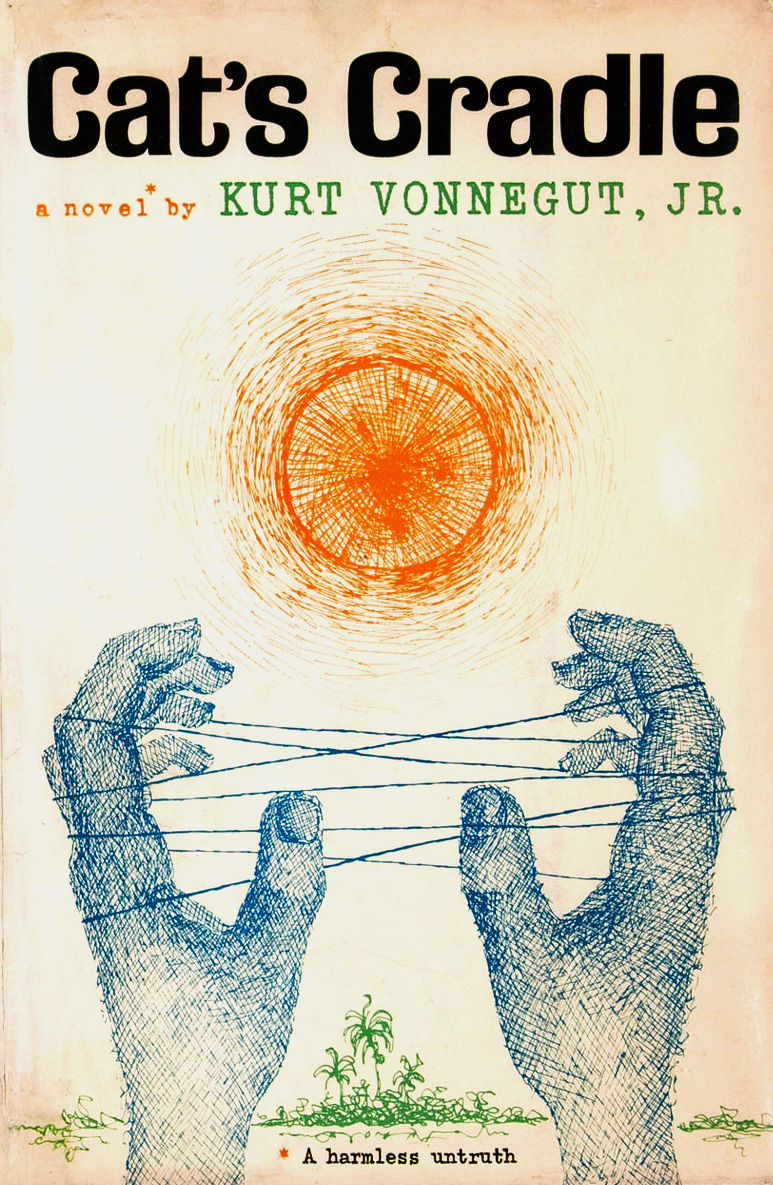
An additional main strand of religious futurism, what we might term creative or speculative religious futurism, relates to invented religious faiths ascribed either to future populations or alien civilisations in SF and cognate genres, such as the Church of All Worlds in Robert Heinlein’s Stranger in a Strange Land, or Bokononism, which Kurt Vonnegut invented for his novel Cat’s Cradle.
Where we get some lack of clarity is in overlaps. There is evidence, for example, that religious futurisms of this latter category can migrate into the previous one. There is some evidence, for example, of people pursuing Bokononism in reality, and clearly Jedi commenced as a created belief system depicted within the Star Wars universe, and was not originally intended to be a religious belief. Indeed, to become one, it had to be fleshed out with doctrine by fans.
But then what of something like Scientology, which emerged from L. Ron Hubbard’s work on Dianetics, and was clearly influenced by his own career as a SF author, but was presented to the world as a revelatory knowledge? Or what of Mormonism, also presented to the world as a revelation, but one which in its origin story as told by proponents clearly contains elements of fantastika, if not overt SF futurism?
There are other anomalies too. What do we make of the non-theist belief system propagated in Iain M. Banks’s Culture novels, where most of the population believe the universe they inhabit to be a simulation? This particular theory, first popularised by Nick Bostrum, is gaining a lot of traction among both physicists and the general public. Is it, too, a religious futurism? Is religious even the correct descriptor? Is futurism?
Simulation Theory
As we expand in focus, the anomalies proliferate in this regard. Given the fantastikal aspect of most revelatory origin stories for religions, are we to retroactively consider all religions as religious futurism at an early stage of their development? If we locate the concept of futurism as relative to now, ie the present day, does that simply create a kind of moving walkway, in which, perhaps, Jedi beliefs will at some point cease to be religious futurism and simply become religion? What, other than the passing of time, is required for it to qualify otherwise?
In my own work on SF and Catholicism, I’ve sought to identify how the Anglophone literary tradition of SF constantly depicts Catholicism of the future as a threat – oppressive, anti-science, threatening to democracy and liberty, totalitarian in many aspects.
But this Catholic futurism is not the same as describing the actual likely organic evolution of Catholicism, which has to its credit, played a significant role in a range of scientific development from genetics to astrophysics, and which in its liberation theology form in Latin America has strenuously defended liberty and democracy from totalitarian regimes.
In other words, I wasn’t attempting to predict the future of Catholicism at all, but rather to chart what future Catholicism signified to the Anglophone culture of the recent past.
Likewise, we need to distinguish Islamofuturism from actual potential futures of Islam, though again the anomalies proliferate. What are we to make of Saudi Arabia, a highly conservative Islamic state, granting citizenship to a robot, the first ever robot citizen of any nation?
Sophie the robot citizen
I don’t claim to have easy answers for such questions. What I hope is that scholars of art, culture, the future and theology can start asking them and similar ones. Only collaboratively can we hope to close in on a working definition of religious futurism.
Okay, I lied. There will in fact by four articles in total on Russell Hoban’s Riddley Walker at the Ponying the Slovos project site.
This one’s the third of four now, and does the heavy lifting, addressing the linguistic structure of Riddleyspeak and navigating through some of the earlier critical perspectives on Hoban’s language invention.
To make up for that, the last one, out in a week or so, is all about Riddley’s legacy – Iain M. Banks’ non-Culture SF, Will Self’s post-apocalypse and Tina Turner’s wig, in other words. Don’t forget to tune in.
Only two weeks after this wonderful documentary about the work of Robert Fisk was released, the man himself is dead.
He was a paragon of journalism, whose doorstop book, The Great War for Civilisation, based on his PhD taken at Trinity College Dublin, is the single best explanation for why we find ourselves in the world we are in. You really should read the book, but for a taster, here’s Fisk speaking at his alma mater about his experiences in the Middle East.
Fisk was a journalist of the old school, by which I mean he believed in travelling to the site of an event to explore it in person, in examining the evidence for himself, in speaking to people (directly and in their own languages ideally) to get a rounded perspective on events, and in doing careful research and taking copious notes to augment his own prodigious knowledge and memory.
In this age when the old gatekeeper media are dying out, being replaced by both the amateur hordes of opinion mongers and influencers on the one hand, and by AI algorithm reportage and platform curation on the other, Robert Fisk’s methods seem like the craftsmanship of a lost age.
His decades of reporting on the affairs of the Middle East – its conflicts, their origins and of course Western interference – stands as a testimony to how proper, factual, neutral journalism was once the norm, or at least the aspiration, before the onset of web 2.0, clickbait, alternative facts and post-truth.
Of course, all journalism is ultimately ephemeral, at best the first draft of history. Fisk however had accrued a depth of knowledge, not only of Middle Eastern cultures and politics, but of the long history which had led to the current affairs he reported on. In order to gather this information together in one place, he wrote a doctoral thesis which eventually became his magnum opus – The Great War for Civilisation.
One often feels as if one needs a doctorate in the fraught and complex history of the Middle East to comprehend why things there happen as they do. Fisk had one, and it showed in his writing. He was fully able to account for his own Westernness in his writing about Islam, Arabs and the Middle East in general, as he had spent many decades imbibing the rich, sour and often bitter history of the West’s engagement with all three. And only a Westerner of his ilk, an Englishman with a military heritage and of ultimately Norse extraction, could have been the credible voice within the West that he was.
It is a tragic sign of the times that the fraught relationship between Islam and the West has entered a deadly new phase, just as the carefully researched journalism that Fisk embodied has been jettisoned almost entirely by news outlets motivated to generate sensationalism for clickbait income. What comes next is likely to be ugly, and I’m sorry we will not have Robert Fisk to help explain it for us.
Fortunately we do have many great creators, artists, writers and filmmakers from Muslim backgrounds who are already hard at work attempting to imagine into being better futures not only for the Middle East, or for Islam, but for the world and indeed all worlds. (Allah, after all, is called God of All Worlds in the Qu’ran.) Many of these – it sometimes feels impossibly like all – are featured in a new text about Islamofuturism.
Islam, Science Fiction and Extraterrestrial Life: The Culture of Astrobiology in the Muslim World has been written by JörgMatthias Determann, and was recently published by Bloomsbury. I have written a full review which will run in Foundationin the fullness of time. But for now, and without wishing to preview that review, I would like to note that Islamofuturism may well be the ultimate resolution for the many problems between Islam and the West which Fisk spent his life exploring and reporting about.
This is, of course, a somewhat utopian position to take, and I am an ardent anti-utopian. (Too many utopian visions result in gulags, thought police and death camps for my liking, no matter how well-intentioned they commence.) Nevertheless, what struck me while reading Determann’s fascinating survey of Islamofuturisms from Indonesia to Syria was the pervasive presence of two things in the multifaceted iterations of this rapidly proliferating genre and movement.
Firstly, the omnipresence of the shadow of The Thousand and One Nights. We have an ongoing origin debte among Western SF about when SF originated. Was it, as I’d argue, in the late 19th century alongside the development of professional science and industrialisation? Many, most prominently Brian Aldiss, argue for Mary Shelley’s Frankenstein (1818) as an origin text, and this is somewhat persuasive. Others see SF in earlier eras and texts – the voyages extraordinaires of the Age of Expansion; the lunar visitation texts of Rome, even in the automata described by Homer in the Iliad, or the “alien spaceships” of the Book of Ezekiel. But these are all from the Western tradition. From an Islamic, Middle Eastern tradition, it makes perfect sense to identify The Thousand and One Nights as a seminal SF text.
Secondly, Islamofuturist cultural outputs almost entirely derive some of their animus from Western SF, according to Determann. Western forms, narrative devices and even sometimes direct lifts of scenes or characters are repurposed by Islamofuturism. Star Wars and Star Trek are huge influences, no less so than the indigenous cultures of Cairo, Istanbul or Jakarta.
What struck me, reading Determann’s book, is the sheer proliferation of Islamofuturism. His text is timely. In only a few years, the kind of survey he has conducted will no longer be possible in a single volume. Instead we will have to talk about Turkish cinematic visions of the future, Egyptian pulp SF novels, Indonesian feminist futurisms, and so on. In all of these environments and genres, Muslim dreamers are creating futures that contain Islam, centre Islam, challenge Islam, modernise Islam and most significantly, find modes of rapprochement between Islam and the West (yes, including revenge myths of total annihilation and takeover, but this is far from the norm.)
Robert Fisk and Islamofuturism thus function as two sides of one coin, or rather, as a Janus statue with one head looking back to the complex origins and sad histories of Western engagement with Islam and the Middle East, while the other looks forward, more in hope than expectation admittedly, to the future.
I hope that the Robert Fisk of a century from now has a happier narrative to write than The Great War for Civilisation. I hope he, or she, Western or Muslim or both or neither, can tell a tale of Islamofuturism and it’s reshaping of Islam and the West.
This was originally published on LinkedIn. At some point, I will likely decide that I have no real purpose or need of a presence there, hence reproducing it here.
The oceans of knowledge are not a safe place for an unwary early career researcher, or academic from the developing world, who needs to publish their work to gain tenure or promotion.
Here be monsters, shady companies who prey on desperate and ill-advised academics. The scam is simple. There is a drive to open source publishing in academia to make knowledge as freely available as possible. This is because academics tend to produce their work as employees of universities, who are then charged by publishers to access that same work. This too could be considered a little unethical, but it is not new. The system, for those unfamiliar with it, is well described here.
No, I’m talking about a more recent development. With the drive to online, publishers have emerged offering to publish academic work for a fee. This fee, they insist, is to cover things like editorial, proofreading, and layout, as well as online hosting costs. However, the fees requested often run into hundreds or thousands of pounds. Unwary academics, often from developing nations, do not always distinguish these ‘journals’ from more respectable ones, which is how they make their money.
Most academics have been spammed at some point by these journals (the respectable ones don’t need to spam to recruit submissions.). Most academics wearily delete the emails. Some academics dream of spamming them back. Sometimes, academics with a little spare time troll the spammers, publishing nonsense articles to highlight their lack of professional standards. There have been articles published on the use of geese in obstetrics, the existence of midichlorians (the fictional cause of Star Wars’ ‘force’), and even an article simply entitled ‘Stop emailing me’, which consisted of that phrase multiply repeated.
I’ve been on parental leave recently, and as I had a day between writing projects and the baby was behaving himself, I decided to bite on the latest spam from an alleged Journal of Advances in Oceanography and Marine Biology. This too is an indicator of a scam journal, when their topic is very distant from your own speciality subject. Mine is not oceanography. I’m a literary scholar who teaches literature and journalism. So, rising to the challenge, I wrote an article about mermaids, selkies, sea monsters and oceans of lard.
They asked for $979 to publish it. We negotiated, while the article allegedly was out for ‘peer review’. Peer review is a system where other academics read your work blind and offer guidance on whether it should be published. It’s a voluntary quality control system, which moves slowly, because academics aren’t paid to do it, and it’s often at the bottom of their large ‘to-do’ lists. Articles can languish in peer review for months, and sometimes even longer. So it is another indicator of a scam journal when your article completes peer review in ten days, as mine did.
Meanwhile, I had beaten the cost down to $50. They got sticky there, because obviously the sales people on the email line like to make their money and this seems to be their floor. Equally, I didn’t intend to pay at all, and I knew that for the scam to work on others, they needed some content. I gambled that they would publish my article for free to lure others. I also gambled that they hadn’t actually read it, and nor had any peer reviewer. The gamble was correct, and you can read my ridiculous article here (until they read this and delete it.) It’s called Speculative Oceanography.
The Times Literary Supplement is entirely correct to demand a reform of the practice of charging universities for work that they themselves produce. But there is a risk that we may then lurch to an even worse situation, where predatory journals scam desperate academics and researchers with ever more prevalence. A brave librarian in the United States used to maintain a list of such predatory journals and publishers, as a guide for academics to consult, but he and his university were threatened with lawsuits from the deep-pocketed publishers, and now that list is no longer updated, though new journals and publishers pop up daily.
As we move to fully open source academic publishing, we need an international quality control system to prevent predatory journals from preying on the unwary. We need to kill off the sea monsters of academia.